
UK businesses are generating more devices than ever — yet the systems designed to handle those devices responsibly are barely keeping pace. Total WEEE collections in the UK reached approximately 496,000 tonnes in 2024, representing a growth of just 0.6% since 2018, despite a consistent year-on-year increase in the volume of electrical equipment being placed on the market. Display equipment volumes alone rose 8% in Q3 2024, and small mixed WEEE by 7%. The gap between what is being deployed and what is being responsibly recovered is widening — and the root cause is not a lack of recycling infrastructure. It is a lack of strategic thinking about the device lifecycle itself.
For most UK businesses, devices are managed reactively. They are procured when needed, issued to employees, forgotten about until they fail, replaced in a hurry, and then left in a storage cupboard or sent straight to a recycler with little documentation and even less consideration of the value still locked inside them. This is not a sustainable approach — financially, operationally, or environmentally.
Device lifecycle management is the structured framework that changes this. It treats every device as a managed asset from the moment it is procured to the moment it is responsibly disposed of or resold — creating visibility, recovering value, reducing risk, and generating the data that modern ESG reporting demands.
This article explains what effective device lifecycle management looks like in practice, why it matters for UK businesses right now, and what concrete steps organisations can take to improve every stage of the process — from first deployment through to final trade-in, resale, or certified recycling.
What Is Device Lifecycle Management?
Device lifecycle management is a structured, end-to-end approach to managing business technology assets throughout their entire operational life. Rather than treating procurement, deployment, maintenance, and disposal as separate, disconnected activities, it frames them as interconnected stages within a single, manageable continuum — one that can be planned, documented, and continuously improved.
For an IT Director or Asset Manager overseeing a fleet of smartphones, tablets, and laptops, this means having defined processes at every stage: how devices are selected and provisioned, how they are tracked and maintained during active use, when and how they are refreshed, and what happens to them at end-of-life. The goal is not process for its own sake — it is visibility, control, cost efficiency, and compliance.
The Key Stages of the Device Lifecycle
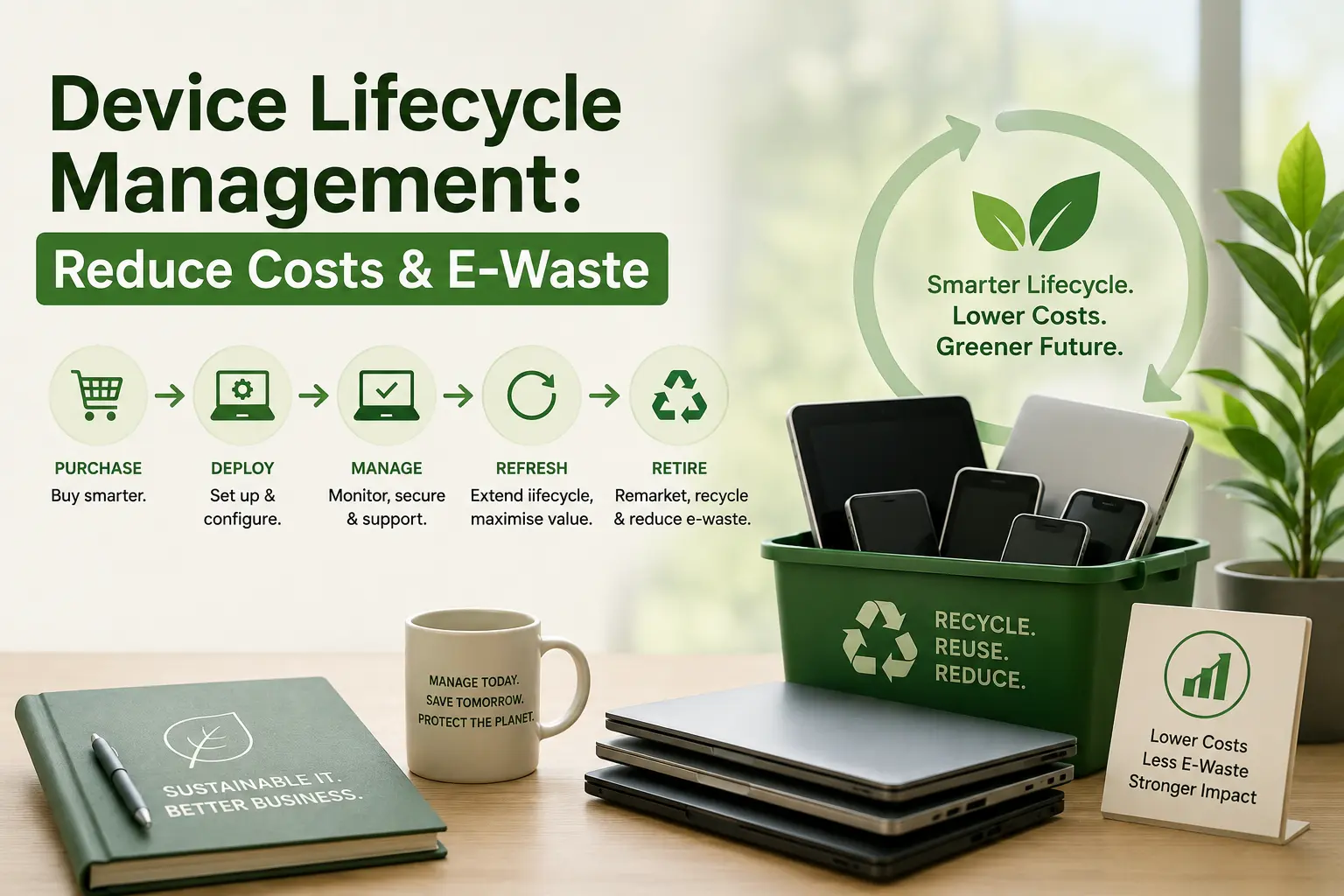
The device lifecycle moves through five broad stages. Procurement and provisioning covers the selection, purchase, and initial configuration of devices. Deployment and active use covers the period when devices are in employees’ hands, supported by IT teams and managed through MDM platforms. Maintenance and support addresses repairs, software updates, and operational upkeep that determine how long a device remains fit for purpose. Refresh and replacement planning involves identifying when devices are due for upgrade, coordinating the logistics of transition, and ensuring outgoing devices are handled correctly. Finally, end-of-life recovery encompasses trade-in, resale, certified data destruction, and responsible recycling or disposal.
Each stage feeds into the next. Poor procurement decisions — buying devices without considering their repairability or residual value — create downstream problems at the disposal stage. Inadequate maintenance shortens device lifespans and accelerates refresh cycles unnecessarily. A well-managed device lifecycle anticipates these interdependencies and plans for them.
Why Most Businesses Manage It Reactively
The reality for many UK SMBs and mid-market businesses is that the device lifecycle is not managed as a coherent strategy at all. Devices are purchased when there is budget, replaced when they break, and disposed of when someone finally notices the pile of retired handsets in the IT room. Each stage is treated as a separate event rather than part of a connected process, and responsibility is fragmented across procurement, IT support, and occasionally finance or HR.
The consequences are predictable: missed opportunities to recover residual value, compliance gaps at end-of-life, inflated procurement costs caused by unplanned emergency replacements, and an inability to report meaningfully on the environmental impact of the organisation’s device fleet. The device lifecycle, left unmanaged, becomes a source of avoidable cost and risk.
The Business Case for Structured Device Lifecycle Management
For IT and procurement leads who need to make an internal case for investing in better processes, the financial and operational argument for structured device lifecycle management is compelling — and it is grounded in numbers, not aspirations.
Recovering Hidden Value from Retired Devices
The UK second-hand and refurbished electronics market was worth £4.3 billion in 2024, with approximately 199 million products in circulation. That figure represents the scale of residual value sitting inside devices that businesses routinely treat as waste. A smartphone or tablet that is two or three years into its deployment cycle still has meaningful market value — but that value depreciates quickly. A device worth £150 today may be worth considerably less in six months’ time, simply because it has been sitting in a storage box while the market moved on.
A structured device lifecycle management process ensures that devices are assessed for resale value before they reach end-of-life, not after. Rather than defaulting to recycling — or leaving devices to accumulate in storage — businesses that trade in devices at the right point in the cycle can recover meaningful cash that offsets the cost of new hardware. The secondary electronics market is not a niche; it has real commercial scale, and businesses that participate in it strategically are at a genuine financial advantage over those that do not.
Reducing the Total Cost of IT Asset Management
The financial benefits of lifecycle management extend beyond trade-in value. Timely maintenance and proactive software management extend device lifespans, reducing the frequency of full refreshes. Planned refresh cycles allow procurement teams to consolidate volumes, negotiate better terms with suppliers, and avoid the premium cost of emergency replacements. Comprehensive asset tracking reduces the administrative overhead of auditing what devices the organisation actually holds — a task that, without proper records, can consume significant IT resource at the worst possible time.
Reactive, fragmented device management generates hidden costs at every turn. Structured lifecycle management does not eliminate those costs — it makes them visible, predictable, and controllable.
Improving Operational Efficiency Across Refresh Cycles
For organisations managing fleets of 50, 100, or 500 or more devices, the operational difference between planned and unplanned refresh cycles is significant. Coordinated replacements reduce employee downtime, ensure that outgoing devices are collected, wiped, and processed in a single logistical movement, and give IT teams the lead time they need to configure and provision new devices properly. Procurement teams benefit from predictable volumes that support supplier negotiations and budget forecasting. The alternative — replacing devices one at a time as they fail, each requiring its own logistics and compliance process — is neither efficient nor scalable.
Device Lifecycle Management and GDPR Compliance
Data security and compliance are among the most critical — and most consistently underestimated — components of the device lifecycle. For IT Directors and anyone with accountability for data protection, the end-of-life stage deserves as much process rigour as day-to-day data handling.
Why End-of-Life Is Your Highest GDPR Risk Point
There is a counterintuitive truth about device-related GDPR risk: the disposal stage is often more dangerous than active use. A device in an employee’s hands is typically enrolled in MDM, protected by encryption, and subject to remote wipe capability. A device sitting in a storage box, waiting to be “dealt with,” may not have been formally unenrolled, wiped, or accounted for in any audit trail. That device still contains data — corporate email, application credentials, cached files — and its status is unknown.
The ICO is clear that organisations must ensure the secure erasure or destruction of data before disposal, maintain documented audit trails of disposed equipment, and hold contracts with any ITAD vendors who process data on their behalf. Under GDPR Article 28, those vendors are acting as data processors — which means due diligence is not optional, and a vague assurance that “data has been wiped” is not sufficient.
What UK GDPR Requires at the Disposal Stage
In practical terms, GDPR compliance at end-of-life requires several things to be in place simultaneously. Data must be securely erased using a certified method — whether through verified software-based wiping aligned with NIST or ADISA standards, or through physical destruction where software erasure is not possible. The process must be documented, with an audit trail that logs which devices were disposed of, when, and through which process. Where a third-party ITAD provider is used, there must be a formal data processor agreement in place, and a Certificate of Destruction must be issued as verifiable proof of compliance.
The regulatory context is also evolving. The Data (Use and Access) Act, coming into force in June 2025, signals that expectations around data handling and disposal are continuing to tighten. Organisations that already have documented, auditable end-of-life processes in place will be better positioned to demonstrate compliance as the regulatory landscape develops.
The Duty of Care Under Environmental Law
GDPR is not the only compliance obligation that applies at end-of-life. Under the Environmental Protection Act, businesses have a legal duty of care to ensure that waste — including electronic waste — is transferred only to licensed waste carriers with proper documentation. The WEEE Regulations impose additional obligations on how electrical equipment is collected, treated, and recycled. Together, these requirements create a multi-layer compliance burden that cannot be met by simply handing devices to an uncertified carrier or disposing of them through general commercial waste channels.
A structured device lifecycle management process, supported by a verified ITAD partner, allows businesses to meet their GDPR, WEEE, and duty of care obligations in a single coordinated step — rather than managing them as separate, ad hoc tasks.
E-Waste, the Environment, and Why Recycling Alone Isn’t Enough
There is a widely held assumption in business that sending devices to recycling represents a responsible environmental outcome. The data tells a different story — and understanding why matters for any organisation serious about its sustainability commitments.
The Scale of the E-Waste Problem in the UK
E-waste is the fastest-growing waste stream globally, with approximately 62 million tonnes generated annually and only around 22% formally recycled. In the UK, total WEEE collections reached approximately 496,000 tonnes in 2024 — just 0.6% higher than in 2018 — despite a steady, year-on-year increase in devices placed on the market. The UK government’s own 2024 WEEE collection target was set at 482,336 tonnes, reflecting the scale of the challenge. Meanwhile, device volumes are rising: display equipment placed on the UK market grew 8% in Q3 2024, and small mixed WEEE by 7%. The recycling system is not keeping pace with what is being deployed — and the gap is not closing.
Why Extending Device Life Delivers Greater Environmental Gains Than Recycling
The carbon economics of device manufacturing provide a compelling reason to prioritise reuse over recycling. A typical smartphone generates approximately 38 to 68 kg of CO₂e across its entire lifecycle, and the majority of that footprint is created during manufacturing — before the device is ever switched on or issued to an employee. This means that once a device exists, the most impactful environmental decision is not how it is eventually recycled — it is how long it remains in productive use.
Extending the useful life of a device by even one or two additional years delivers disproportionate carbon savings compared to the gains achievable through recycling at end-of-life. Recycling recovers materials, but it cannot undo the emissions already embedded in the manufacturing process. Reuse avoids the need to manufacture a replacement device in the first place. These are not equivalent outcomes, and they should not be treated as such in sustainability strategy.
The Circular Economy Case for Business Device Fleets
The practical implication for businesses is straightforward: recycling should be the last resort, not the default. A circular economy approach to the device fleet prioritises reuse, refurbishment, and resale. Devices that are still functional at the end of a corporate refresh cycle should re-enter the market — either through direct trade-in, resale, or refurbishment — where they can deliver value to another user rather than being broken down for raw materials. Only devices that are genuinely beyond economic repair should proceed to responsible recycling, and even then, zero-landfill standards should be the baseline expectation, not a premium option.
The UK’s £4.3 billion secondary electronics market demonstrates that this approach has genuine commercial scale. Businesses that participate in it are not making a concession on sustainability — they are adopting the superior environmental and financial outcome simultaneously.
ESG Reporting and Device Lifecycle Management
For UK businesses facing growing pressure to report on their environmental and social impact, device lifecycle management is not just an operational discipline — it is a source of measurable, reportable ESG outcomes.
How Device Decisions Feed Into Scope 3 Emissions Reporting
Devices sit within a business’s Scope 3 emissions footprint — the indirect emissions associated with the products it purchases and disposes of. As Scope 3 reporting gains traction through frameworks such as the GHG Protocol and CDP, the decisions businesses make about device refresh cycles, reuse versus recycling, and end-of-life handling increasingly carry reportable carbon implications. A structured device lifecycle management process creates the audit trail and outcomes data needed to quantify these impacts — something that organisations managing devices reactively and without documentation simply cannot produce.
What Good ESG Reporting Looks Like for Device Fleets
Measurable ESG outputs from a well-managed device lifecycle include tonnes of e-waste diverted from landfill, carbon savings attributable to device reuse and refurbishment, the number of devices resold versus recycled, and verified documentation of responsible disposal methods. For sustainability officers and ESG leads, these are not abstract aspirations — they are the figures that populate annual sustainability reports, respond to supplier questionnaires, and inform board-level presentations.
Importantly, these outcomes do not require a separate ESG programme or additional investment. They are the natural by-product of a well-run device lifecycle management process. iGo Trade In, for example, provides an ESG impact report alongside every trade-in, quantifying carbon savings and e-waste diversion as part of the standard service — making it straightforward for businesses to translate operational decisions into reportable sustainability data without additional overhead.
The Five Principles of Effective Device Lifecycle Management
Translating device lifecycle management from concept to operational practice does not require a complete transformation of IT processes overnight. It does require a clear framework, consistently applied. The following five principles provide a practical starting point for any UK business looking to improve how it manages its device fleet.
1. Start With a Comprehensive Asset Register
Effective device lifecycle management begins with visibility. Without an accurate, up-to-date asset register — one that records what devices the organisation holds, who has them, when they were deployed, what condition they are in, and when they are due for replacement — every subsequent decision is made in the dark. Procurement planning is guesswork. Refresh scheduling is reactive. Compliance at the end-of-life is improvised. An asset register is not a bureaucratic overhead; it is the operational foundation on which everything else depends.
2. Plan Refresh Cycles Proactively, Not Reactively
For corporate smartphones and tablets, a planned refresh cycle of every 24 to 36 months balances device performance, security currency, and residual value recovery. Organisations that wait until devices fail — or until employees complain loudly enough — consistently miss the window of peak trade-in value, create logistical chaos, and lose the procurement leverage that comes with predictable volumes. Planned cycles allow businesses to coordinate collections, negotiate with suppliers, and ensure that outgoing devices are processed at the right point in their depreciation curve.
3. Extend Device Life Where It Makes Financial and Environmental Sense
Not every device that reaches the end of a standard refresh cycle needs to be replaced immediately. Some devices remain well within acceptable performance parameters for lower-intensity roles — issued to new starters, deployed as shared devices, or retained as managed spares. Every additional month of productive use reduces the cost of replacement and contributes to a lower Scope 3 carbon footprint. Extending device life intelligently is not a compromise; it is a deliberate, value-generating decision.
4. Prioritise Certified, Auditable End-of-Life Processes
When devices do reach genuine end-of-life, the process must be documented, verifiable, and compliant with both GDPR and WEEE obligations. This means working exclusively with an ITAD partner that provides certified data destruction aligned with NIST, ADISA, and ISO standards; issues Certificates of Destruction; and maintains full chain-of-custody documentation throughout. Sending devices to an uncertified recycler, allowing informal disposal routes, or relying on unevidenced assurances is not an acceptable compliance posture under current ICO guidance — and it will become less acceptable still as the Data (Use and Access) Act comes into force.
5. Recover Value Before You Recycle
Before any device enters a recycling stream, its resale potential should be assessed. Given that the UK second-hand electronics market is worth £4.3 billion annually, the probability that a batch of retired corporate devices contains meaningful residual value is high — and that value disappears the longer it is left unrecovered. Devices with remaining market value should be traded in or resold; only those genuinely beyond economic reuse should proceed to responsible recycling. iGo Trade In’s self-service portal allows businesses to input their devices and receive instant valuations, arrange collection — whether by dedicated van for larger fleets or pre-paid courier for smaller batches — and receive certified data destruction, payment within 14 days, a Certificate of Destruction, and an ESG impact report, all as part of a single managed process.
Choosing the Right ITAD Partner for End-of-Life Device Management
The quality of an organisation’s end-of-life device management is only as good as the partner delivering it. Choosing the wrong ITAD provider is not merely an operational inconvenience — it is a compliance risk with potentially significant financial and reputational consequences.
Key Criteria for Evaluating an ITAD Provider
Several criteria should be non-negotiable when evaluating any ITAD provider. The provider should be registered as an Upper Tier waste carrier, broker, and dealer with the UK Environment Agency — this is the baseline legal requirement for handling business waste, and its absence is an immediate disqualifier. Data destruction processes should be certified to recognised standards, including NIST, ADISA, and ISO, with the methodology clearly documented and verifiable. Full chain-of-custody documentation should be provided from point of collection through to final disposition, and a Certificate of Destruction should be issued for every batch as standard. Critically, the provider should be able to scale with the organisation’s needs — processing 20 devices or 2,000 through the same documented, compliant process.
iGo Trade In meets all of these criteria: registered as an Upper Tier waste carrier, broker, and dealer with the UK Environment Agency; certified data destruction to NIST, ADISA, ISO, and GDPR standards; full audit documentation; and ESG impact reporting included as standard with every trade-in.
Why Transparency and Documentation Matter More Than Price
The lowest-cost disposal option is rarely the right choice once compliance obligations are factored in properly. An ICO investigation following a data breach traced to improperly disposed devices does not resolve itself cheaply, either financially or reputationally. The value of a Certificate of Destruction, a GDPR-compliant data processor agreement, and a complete audit trail is not found in the paperwork itself — it is found in the protection that paperwork provides when questions are asked. Prioritise partners that are proactive in their reporting, contractually committed as data processors under GDPR Article 28, and transparent about what happens to devices after collection.
Common Mistakes That Undermine Device Lifecycle Management
Even organisations with good intentions frequently undermine their own device lifecycle management through a small number of predictable mistakes. Recognising them is the first step to avoiding them.
Letting Devices Accumulate in Storage
The most common and costly mistake is allowing retired devices to sit in IT stockrooms or office drawers while their residual market value depreciates steadily. Device values are not static — the secondary market moves quickly, and a device worth £150 today may command considerably less in six months’ time. Stockpiled devices represent not just missed financial recovery but also undocumented, unmanaged assets that sit outside any compliance process. Timely trade-in is straightforward financial management, and it is also a compliance obligation.
Treating Disposal as an Afterthought
Organisations that plan meticulously for procurement and deployment but have no defined end-of-life process are accumulating exposure across compliance, cost, and sustainability simultaneously — often without realising it until a problem forces the issue. End-of-life should be built into the device lifecycle strategy from day one, not improvised when a storage cupboard runs out of space or an audit raises questions about documentation. The disposal stage is too consequential — financially, legally, and environmentally — to be treated as an administrative detail.
Relying on Informal or Unverified Disposal Routes
Donating devices to staff, passing them to an unapproved carrier, or disposing of them through general commercial waste channels creates both GDPR and WEEE compliance risk. Every device that leaves the organisation’s control must follow a documented, compliant process. The convenience of informal routes does not outweigh the liability they introduce — and under current ICO guidance, “we thought it was handled” is not a defence that holds.
Taking a More Strategic Approach to the Device Lifecycle
Device lifecycle management is not a specialist discipline reserved for large enterprises with dedicated ITAD teams. It is a practical, scalable approach to managing business technology assets that delivers measurable returns at every stage — from recovered hardware value and reduced procurement costs, to auditable GDPR compliance and credible ESG reporting.
The businesses that manage the device lifecycle well are not necessarily the ones with the largest IT budgets. They are the ones that treat devices as assets rather than consumables, plan refresh cycles proactively rather than reactively, and work with partners who can handle end-of-life with the same rigour they apply to procurement.
If your organisation is approaching a device refresh, managing an inherited stockpile of retired hardware, or simply looking to bring more structure to how devices are handled at end-of-life, iGo Trade In provides a straightforward entry point.
For businesses looking beyond trade-in, the broader iGo Life ecosystem covers the full device lifecycle: iGo Fulfilment provides access to wholesale refurbished IT hardware and smartphones; iGo Recycle handles secure collection, certified data destruction, and responsible recycling for devices beyond economic reuse; and iGo Bespoke delivers customised tech accessory bundles tailored to corporate requirements. Together, they provide a coherent, end-to-end alternative to fragmented, reactive device management.
Visit igotradein.co.uk to get started, or reach out to the team at iGo Life to discuss how a managed approach to the device lifecycle could work for your organisation.
