
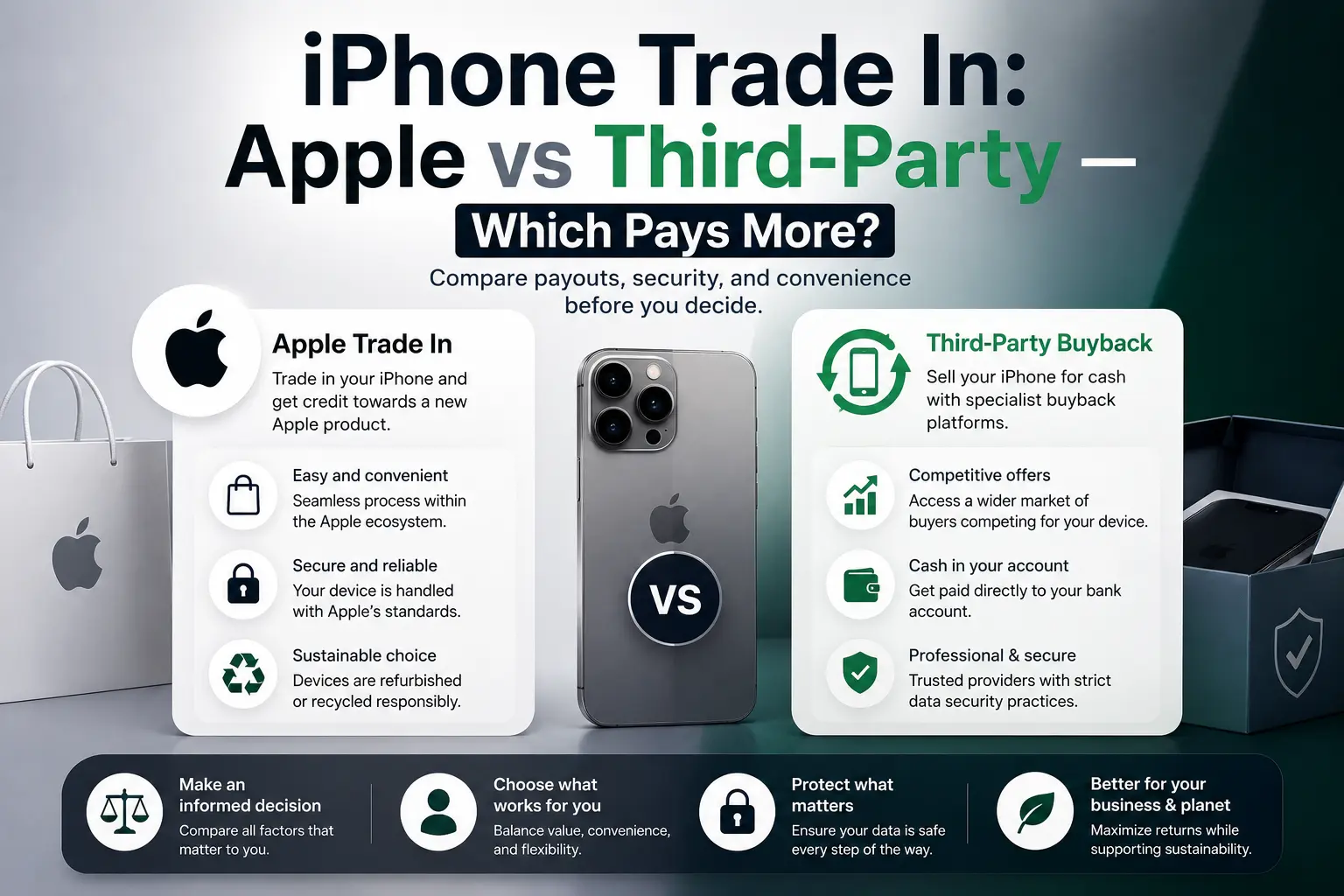
Millions of iPhones are retired across the UK every year — in homes, on office desks, and across corporate device fleets. Yet the majority of owners, and a surprising number of IT teams, end up choosing their trade-in route based on habit or convenience rather than genuine financial comparison. The result is often a significant amount of money left on the table.
This guide is designed to change that. Whether you are upgrading a single device or managing a fleet refresh involving hundreds of handsets, understanding where your iPhone trade-in value actually goes — and which channel pays more — is worth the time it takes to read this properly. The headline finding is this: third-party buyback platforms typically pay around 20–25% more than Apple’s own trade-in scheme for the same device in the same condition. For an individual, that gap is meaningful. For a business, it can represent thousands of pounds in recoverable capital that never needed to be sacrificed.
This is not a brand critique of Apple, nor is it a straightforward endorsement of any single alternative. It is an evidence-based comparison designed to help you make an informed decision.
How Apple Trade In Actually Works in the UK
Apple’s trade-in programme is genuinely well-designed for one specific purpose: making it easier for customers to buy a new Apple product. The process is straightforward — you use Apple’s online valuation tool, receive an estimated trade-in value, apply that value as credit toward a new device purchase, and return your old handset either by post or at an Apple Store. The old device is then processed and either refurbished or recycled downstream.
What is less prominently advertised is that this value is almost always issued as store credit rather than cash. That distinction matters enormously, particularly for businesses. Store credit is useful if you are buying directly from Apple — but it is locked tightly to the Apple ecosystem, which creates budget inflexibility if your procurement plans change or your estate includes non-Apple hardware.
It is also worth understanding that Apple is functioning here as a front-end channel, not the end buyer. The actual processing and resale of trade-in devices is handled by third-party downstream processors. That means the same secondary market that specialist buyback platforms access is ultimately involved — but with Apple taking a margin, and passing on less to the device owner.
What Apple Accepts — and What It Won’t
Apple’s eligibility criteria are relatively strict. The programme accepts a range of iPhone models, but devices that are cracked, have swollen batteries, or show significant physical damage are often refused outright or receive a sharply reduced offer. Carrier-locked handsets are more likely to be declined or devalued, and iCloud Activation Lock must be fully removed before any trade-in can proceed. If a device fails eligibility at the inspection stage — which happens after you have already sent it in — Apple will issue a revised (lower) offer or return the device. For businesses managing mixed-condition fleets, this unpredictability adds friction to what Apple positions as a seamless process.
How Apple Calculates Your Trade-In Value
Apple’s valuation is based on iPhone model, storage capacity, physical condition, and carrier lock status. The process delivers a fixed offer — there is no competitive dynamic, no comparison against other buyers, and no reflection of live secondary market pricing. Given that smartphone resale values fluctuate daily, a fixed valuation from a single source is an inherently conservative approach. It protects Apple’s margins rather than maximising the seller’s return.
How Third-Party Buyback Works — and Why It Often Pays More
The UK third-party buyback market includes a range of specialist resale platforms, ITAD (IT Asset Disposition) providers, and price comparison aggregators. The underlying business model explains why they frequently outbid Apple: these platforms compete for device stock and resell into UK, EU, and global refurbished markets. Because they are in direct competition with one another for the best-condition devices, they are structurally incentivised to price more aggressively.
The numbers bear this out. Based on 2026 UK market data, an iPhone 15 Pro Max attracts approximately £370 via Apple’s trade-in scheme and around £458 through a third-party resale channel — a difference of roughly 24%. An iPhone 14 comes in at approximately £180 via Apple versus £224 via third-party, again around 24% higher. Earlier UK comparisons found differences of up to £100 per device in favour of third-party buyers. Across a fleet of 50 or 100 devices, those figures compound rapidly into a recovery gap that is difficult to justify ignoring.
The trade-off, as it exists, is one of process rather than trust. Third-party routes typically involve slightly more steps — obtaining quotes, arranging logistics, and ensuring data security standards are met — but for most businesses, that additional effort is well justified by the financial outcome.
Payment in Cash, Not Credit
One of the most practically significant differences between Apple Trade In and specialist buyback services is the payment method. Reputable third-party platforms pay via bank transfer — real, flexible capital that can be applied to any cost centre, reinvested, or allocated to the next procurement cycle. For a business trading in 100 iPhones, receiving £22,400 in cash is a materially different outcome from receiving £18,000 in Apple Store credit that can only be used for future Apple hardware purchases.
Turnaround Times and Logistics
For individual or smaller volume trade-ins, most third-party platforms offer pre-paid courier packaging — straightforward and low-effort for the device owner. For larger fleet refreshes, specialist ITAD-grade providers offer dedicated van collection, which removes the internal handling burden entirely and is better suited to high-volume decommissioning. Payment timelines from reputable providers typically run within 14 days of device receipt and inspection — a useful benchmark when evaluating any service. Apple’s trade-in timeline, by contrast, is tied to a new device purchase and delivery, making it less useful as a standalone recovery mechanism.
What Affects Your iPhone Trade-In Value — Regardless of Channel
Whichever route you choose, several device-level variables will determine the offer you receive. Understanding these levers helps you maximise recovery and avoid avoidable reductions.
iPhone Model and Generation
Model generation is the single largest driver of trade-in value. Pro and Pro Max variants command substantially higher returns than standard models of the same generation. Newer devices retain more value, but mid-cycle models — particularly the iPhone 13 and 14 series — still represent meaningful recovery, especially at volume. Knowing exactly what models are in your fleet before submitting a trade-in is basic due diligence that pays off.
Storage Capacity
Higher storage configurations attract meaningfully better offers across all channels. A 256GB or 512GB model will consistently outvalue its 128GB equivalent, and the gap widens further at 1TB. For businesses tracking device assets, capturing storage configuration at the individual device level — not just model name — can make a significant difference to total recovery across a large batch.
Physical Condition and Screen Integrity
Most platforms apply a condition grading framework — typically Grade A (excellent), Grade B (good), and Grade C (heavy wear) — and price accordingly. Cracked screens, battery swelling, and non-original components reduce offers substantially. It is worth being accurate in your self-assessment before submitting: if your stated condition does not match what arrives at inspection, the offer will be revised downward, and you will have lost time in the process.
Carrier Lock Status
Unlocked iPhones are worth more across every channel because they appeal to a wider resale market. Network-locked devices are either declined or priced at a discount to reflect the narrower buyer pool. Businesses running contract-tied devices should confirm unlock eligibility with their network provider before initiating any trade-in process.
Market Timing and Demand Cycles
This is among the most overlooked variables in device fleet strategy. iPhone trade-in values reliably spike in the weeks around new Apple product launches, as buyer demand increases ahead of anticipated supply. Once new devices launch and used stock volumes rise, values depreciate steadily. Secondary market pricing fluctuates daily. For businesses planning a fleet refresh, coordinating trade-in submission to coincide with these demand peaks can meaningfully increase total recovery — without any change to the devices themselves.
The “Convenience Tax” — What You’re Really Paying for Apple Trade In
Apple Trade In is a genuinely convenient service. If you are standing in an Apple Store about to buy a new iPhone and want to reduce the bill with minimal effort, the trade-in process is fast and frictionless. But that convenience comes at a measurable cost — approximately 20–25% of your device’s market value.
For an individual consumer, this might be a reasonable trade. For a business retiring 100 iPhones, it is a different calculation entirely. If the average gap between Apple’s offer and a competitive third-party buyback is £70 per device, a fleet of 100 handsets represents £7,000 in unrecovered value. At 200 devices, that is £14,000. These are not hypothetical numbers — they are consistent with the pricing differences documented in UK market comparisons.
None of this means Apple Trade In is a bad product. It is simply a product designed for a specific purpose: reducing friction at the point of a new Apple purchase. If maximising financial recovery from retiring devices is your primary objective — which it should be for most businesses — Apple Trade In is not the optimised tool for that job.
Data Security — The Consideration That Goes Beyond Payout
Financial return is not the only variable that matters. For businesses disposing of corporate devices, data security is a compliance requirement — and choosing the wrong trade-in channel can create real regulatory exposure.
The ICO is clear on this point: organisations must ensure complete, irreversible data destruction before any device is reused or disposed of. That data must not be recoverable “even by professional data recovery experts.” This applies explicitly to mobile phones and tablets, and the guidance is under active review following the Data (Use and Access) Act coming into force in June 2025.
What Apple’s Process Covers
Apple’s trade-in process includes guidance on performing a factory reset and removing the device from your iCloud account. For a consumer device containing personal photos and messages, this may be adequate for practical purposes. For a corporate device that has been used to access company email, CRM systems, sensitive client data, or internal communications, it does not meet the standard required under GDPR or ADISA guidelines. A factory reset is not certified data destruction, and it does not produce the audit trail that regulators and auditors increasingly expect.
What to Look for in a Third-Party Buyback Service
Certified data destruction, in the context of ITAD, means something specific: NIST-standard overwriting, ADISA-certified processes, a documented chain of custody from device collection through to confirmed data sanitisation or physical destruction, and a Certificate of Destruction issued per device. Not every third-party buyback platform provides this — many consumer-facing comparison sites do not. Before engaging any provider for corporate device disposal, verify their ADISA certification, confirm they hold UK Environment Agency waste carrier registration, and ensure they can provide documented evidence of the destruction process.
This is where specialist B2B providers differ materially from consumer trade-in platforms. iGo Trade In, for example, is purpose-built for corporate device disposal, providing certified GDPR-compliant data destruction, ADISA-aligned processes, and a Certificate of Destruction as standard — alongside the buyback payout itself.
ESG and Sustainability — Does Your Trade-In Route Actually Matter?
The short answer is yes, and increasingly so. The channel through which a business disposes of its devices has direct implications for ESG reporting, not just for the balance sheet.
The UK generated approximately 1.17 million tonnes of WEEE in 2025, with around 40% of that not formally collected or recycled. iPhones, which retain over 40% of their original value after 12 months — significantly more than most Android devices, which retain closer to 20% — are among the most reusable assets in any corporate device fleet. Routing them through a reuse-first channel, rather than a recycling-only pathway, delivers measurably greater carbon savings and makes for more substantive ESG disclosures.
Research supports this clearly: reuse delivers greater net climate benefit than recycling alone. A refurbished iPhone that displaces the manufacture of a new device represents a significantly greater carbon saving than one that is shredded for material recovery.
Regulatory and board-level pressure on this front is growing. The Environment Agency has increased scrutiny on reuse versus recycling reporting, and sustainability teams at UK businesses face rising expectations — from clients, investors, and regulators — to demonstrate e-waste diversion and carbon savings with actual data, not general statements.
Apple Trade In provides minimal reporting on carbon impact or device reuse. Specialist ITAD providers can generate granular ESG impact reports that include e-waste diversion metrics, carbon savings per device, and the audit trail to support those figures in supplier questionnaires, sustainability reports, and net zero disclosures. iGo Trade In includes ESG impact reporting as a standard component of every trade-in — not an optional add-on.
When Apple Trade In Makes Sense
A balanced assessment requires acknowledging the scenarios where Apple’s scheme is genuinely the right choice. If you are upgrading a single personal iPhone and plan to apply the credit immediately toward a new Apple device, the convenience-to-value trade-off is reasonable and the difference in absolute terms may be modest. Similarly, if the gap between Apple’s offer and a competitive third-party quote is small for a particular model, and the time saved by using Apple’s integrated checkout process has genuine value to you, the decision is defensible.
For organisations that procure exclusively through Apple, have a long-term commitment to Apple hardware, and have no foreseeable mixed-device purchasing plans, store credit is arguably as useful as cash. The point is not that Apple Trade In is always the wrong answer — it is that it works best when financial recovery is not the primary goal, and when the credit will be used immediately and in full.
Practical Tips to Maximise Your iPhone Trade-In Value
Regardless of which route you choose, the following steps will help you extract the most value from your device or fleet:
- Act sooner rather than later. Depreciation is constant and relentless. Every week, a device sits unused, its market value declines. There is no financial case for delay.
- Time around new launches. Trade-in values peak in the weeks before and immediately after new iPhone announcements. Plan fleet disposals to align with these windows where possible.
- Unlock your device before trading. An unlocked iPhone is worth more across all channels. Contact your network provider to confirm unlock eligibility in advance.
- Be accurate with the condition. Overstating the condition leads to revised offers after inspection, adding delays and frustration. Honest grading from the outset produces cleaner, faster transactions.
- Check storage configuration. Know the storage tier of every device in your fleet before submitting valuations. Higher-storage models attract materially better offers.
- Get multiple quotes. Use comparison platforms or approach more than one provider before committing. The spread between offers can be significant.
- For businesses: consolidate batches. Trading in devices as a single organised lot rather than sending handsets ad hoc typically unlocks better rates and reduces internal handling costs substantially.
- Wipe data correctly. Follow ICO guidance as a minimum. For corporate devices, use a provider that offers certified data destruction and issues a Certificate of Destruction.
What This Means for Businesses Managing Device Fleets
For IT directors, procurement leads, and asset managers overseeing corporate iPhone fleets, the trade-in channel decision is a financial and compliance matter simultaneously — not simply a housekeeping task.
iPhones are among the highest residual-value assets in any device estate. Trading them in via a scheme optimised for consumer convenience, rather than one built around corporate value recovery, means accepting a structural payout reduction of 20–25% per device. Across a fleet of 200 handsets, that is a material budget impact. Across a multi-year refresh cycle, it is a recurring cost that accumulates quietly in the background.
Beyond the financial dimension, GDPR compliance requires verifiable, certified data destruction — not a factory reset. And as ESG reporting obligations grow, organisations need providers capable of generating the granular impact data that boards, clients, and regulators are beginning to require. These are not requirements that consumer-facing trade-in tools are built to meet.
B2B platforms such as iGo Trade In are built specifically for this context: offering instant bulk valuations, flexible collection logistics that scale from a pre-paid courier box for smaller batches to a dedicated van for large fleet decommissions, certified data destruction with full audit trails, payment within 14 days, and ESG impact reporting included as standard. For businesses that also need to manage procurement of refurbished hardware or secure recycling of beyond-repair devices, iGo Life’s broader ecosystem — spanning iGo Fulfilment, iGo Recycle, and iGo Bespoke — covers the full device lifecycle without requiring multiple vendors.
The evidence is consistent:
For most iPhone owners, and especially for businesses managing device fleets, third-party buyback delivers materially higher financial returns than Apple Trade In — alongside cash payment rather than store credit, better data security options, and the ability to generate meaningful ESG reporting. Apple Trade In has genuine value in specific circumstances, particularly for individual consumers making a direct like-for-like Apple upgrade, but it is not optimised for value recovery at scale.
The direction of travel is clear. As WEEE regulation tightens, ESG expectations increase, and device fleets are increasingly recognised as recoverable financial assets, the choice of trade-in route is becoming a deliberate strategic decision rather than an administrative afterthought. The businesses that treat it as such will recover more capital, carry less compliance risk, and generate more credible sustainability disclosures than those that default to the most convenient option available.
If you are reviewing your current approach to iPhone trade-in — whether for a single device or an estate of hundreds — the practical starting point is straightforward: compare quotes before committing, verify data security credentials before handing over any corporate device, and consider whether a specialist B2B service is better suited to your needs than a consumer-facing scheme. For businesses ready to explore a purpose-built route, igotradein.co.uk is a practical next step.

Leave A Comment