
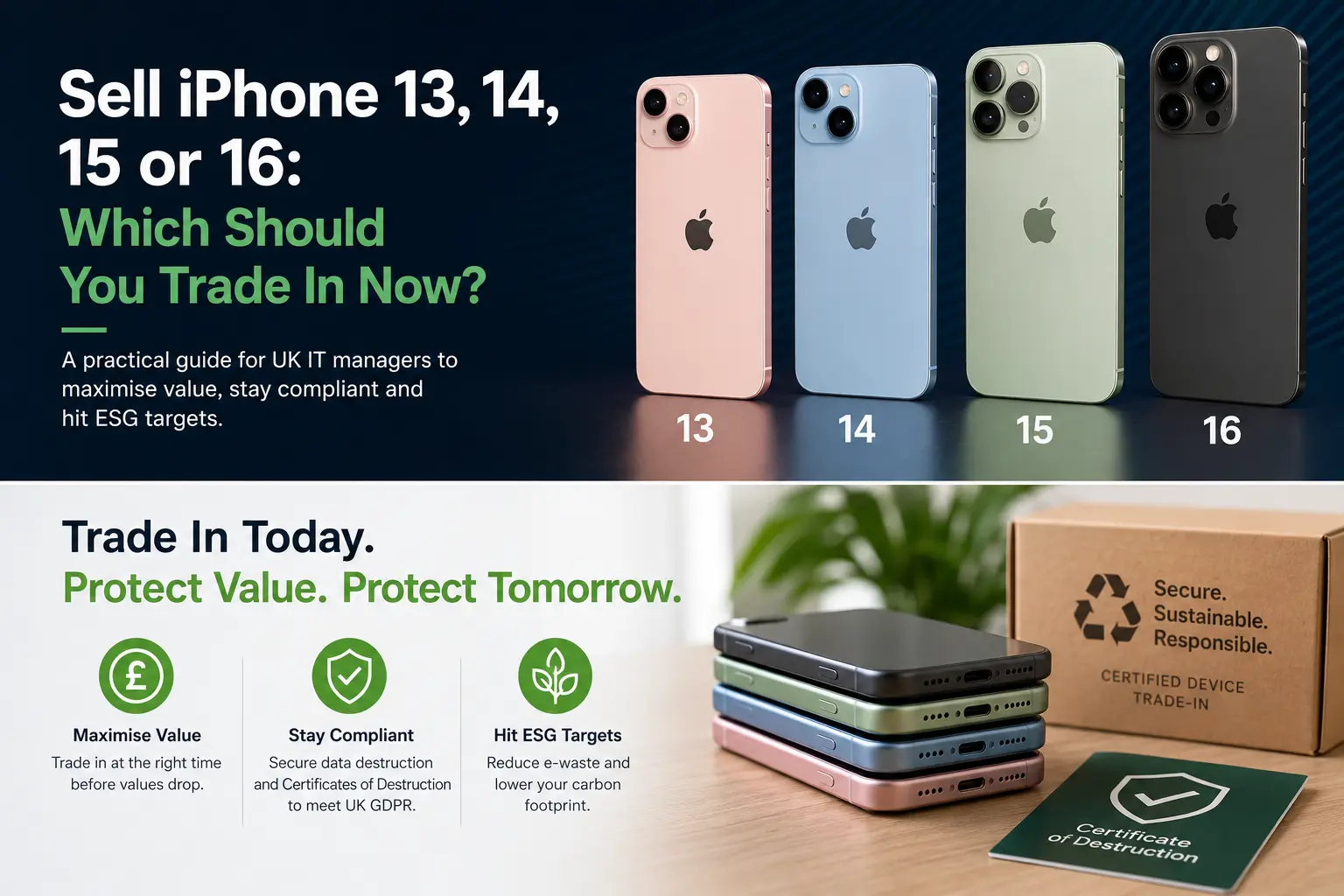
If you’re planning to sell iPhone 13 devices from your business fleet, timing matters more than most organisations realise. Across the UK, millions of smartphones are retired every year, yet many companies miss the optimal resale window and lose significant recoverable value. This guide explains whether now is the right time to sell iPhone 13, iPhone 14, iPhone 15, or iPhone 16 devices and maximise your return.
Why Trade-In Timing Matters More Than You Think
Smartphone Value Drops Fast — Especially After Year Two
The financial case for getting trade-in timing right is not subtle. Industry resale analysis indicates that smartphones can lose 40 to 50% of their value within just two years of release, with further steep declines occurring between years three and four as devices cross into what the secondary market classifies as the low-value “budget tier.” At that stage, buyback prices plateau at significantly reduced levels — and recovery options narrow accordingly.
When you multiply even a modest per-device difference across a corporate fleet of 100, 200, or 500 handsets, the financial gap between trading in at the right moment versus waiting one more cycle becomes substantial. Timing is not an administrative footnote in the asset management process — it is a genuine lever for cost recovery that deserves the same planning rigour as procurement.
The Enterprise Refresh Cycle vs the Optimal Resale Window
The average enterprise mobile device lifecycle sits at approximately three years. The challenge is that the steepest period of value loss falls precisely within that same window. By the time most IT teams complete a refresh planning exercise, commission internal approvals, and begin the logistics of collection, a meaningful portion of the fleet’s residual value has already eroded.
Reframing trade-in as a financially strategic decision — one that starts at the same time as refresh planning, not after it — is the shift that separates businesses that recover real value from those that simply dispose of assets.
Sell iPhone 13, 14, 15 or 16: Which Models Should You Trade In Now?
Each of the four iPhone generations under discussion — 13, 14, 15, and 16 — is at a distinctly different stage in its resale lifecycle as of 2026. Rather than comparing specifications, what follows focuses on lifecycle position, depreciation trajectory, and trade-in urgency. The aim is to give IT decision-makers a clear, practical read on each model so they can make an informed call on timing.
Sell iPhone 13 in 2026: Why the Window Is Closing
Where the iPhone 13 Sits in Its Lifecycle
The iPhone 13 is approaching five years old, placing it firmly at the tail end of its peak resale window. At this lifecycle stage, devices begin crossing into the budget tier of the secondary market, where buyback prices are materially lower, and the trajectory is downward with each passing quarter. The market data support a sense of urgency here.
According to Compare and Recycle’s 2025 UK market review, the iPhone 13 was the most recycled phone in the UK last year, generating £2.7 million in value recovery and avoiding an estimated 864,694 kg of CO₂ emissions. That level of market activity signals something important: enterprise fleets are already exiting at scale. Businesses that are still holding iPhone 13 devices may find the window for meaningful financial return closing quickly.
The Case for Trading In Your iPhone 13 Fleet Now
For IT managers who deployed iPhone 13s as part of a standard three-year refresh cycle, those devices are now overdue. Any further delay compounds two risks simultaneously: financial and compliance.
On the financial side, the depreciation curve at year five is unforgiving. On the compliance side, older devices sitting in storage — a desk drawer, an equipment cupboard, an unopened returns box — are not dormant assets. They are live GDPR liabilities until they have been formally processed and issued with a Certificate of Destruction. Under UK GDPR, data must be irrecoverably destroyed before any device is resold or recycled, and the ICO is clear that a factory reset alone may not meet that standard.
Trading in iPhone 13 fleets now simultaneously recovers remaining cash value, closes compliance gaps, and reduces e-waste before residual value declines further.
iPhone 13 and the USB-C Transition
The iPhone 13 is a Lightning-era device. With Apple standardising on USB-C from iPhone 15 onwards, the broader ecosystem is shifting — and that shift increasingly affects secondary market dynamics. Accessory compatibility, enterprise charging infrastructure, and buyer preference in the refurbishment market are all moving toward USB-C. The iPhone 13’s Lightning connector is not yet a disqualifying factor for resale, but it is a pressure that will compound with time, adding another dimension to the case for moving now.
iPhone 14 (2022): Approaching the Decline — Plan Your Exit
Where the iPhone 14 Sits in Its Lifecycle
At approximately four years old, the iPhone 14 is entering what resale analysts and ITAD professionals identify as the steepest phase of its depreciation curve. It retains more residual value than the iPhone 13 at this point, but that gap is narrowing. The difference between choosing to sell iPhone 14 devices within the current refresh cycle versus deferring by 12 to 18 months represents real per-unit value loss — and across a fleet, that compounds quickly into a material financial variance.
The Lightning Factor: Why the iPhone 14 Faces Extra Resale Pressure
The iPhone 14 holds a specific distinction that adds commercial weight to the trade-in timing question: it is the last Lightning-based iPhone generation ever produced. With the iPhone 15 and 16 both standardised on USB-C, the secondary market for Lightning devices will contract progressively as accessory ecosystems shift and buyer preference aligns with USB-C compatibility. This is not a future theoretical risk — it is already a pricing factor in the refurbishment market. For IT managers assessing fleet value, the Lightning-to-USB-C transition gives the iPhone 14 a structural depreciation pressure that other four-year-old devices in different product lines may not share.
Trade-In Recommendation: Plan Now, Execute Within the Next Refresh Cycle
If you are managing an iPhone 14 fleet and trade-in planning is not already underway, now is the time to start. The optimal action window is the current or next refresh cycle. It is worth noting that the lead time involved in a well-executed corporate trade-in — fleet audit, valuations, logistics scheduling, data wipe processes, and Certificate of Destruction issuance — means that decisions made today translate to value recovered over the next six to twelve months. Starting the planning process later simply shifts that window further into a steeper part of the depreciation curve.
iPhone 15 (2023): The Optimal Window — Strong Value, Real Urgency
Where the iPhone 15 Sits in Its Lifecycle
At approximately three years old, the iPhone 15 sits at what resale analysts and ITAD professionals consistently identify as the optimal trade-in point. It is early enough to retain strong secondary market demand and late enough that a fleet refresh is commercially justifiable on a standard enterprise cadence. For IT teams operating on a three-year refresh cycle, iPhone 15 fleets are precisely at the moment where acting now delivers the strongest financial return.
This is not a marginal advantage. Devices in this mid-lifecycle range attract robust demand from the refurbishment market, where buyers are actively seeking quality stock. Waiting 12 months moves these devices further down the depreciation curve and reduces their eligibility for premium-tier refurbishment channels.
USB-C and the Secondary Market Advantage
Unlike the iPhone 13 and 14, the iPhone 15 was Apple’s first USB-C model — aligning it directly with the direction of the broader market and with enterprise charging infrastructure increasingly being built around USB-C compatibility. This positions the iPhone 15 more favourably in secondary market terms and among refurbishment buyers, supporting stronger and more sustained demand. For IT managers comparing the relative urgency of trading in different models, this compatibility advantage is a genuine differentiating factor.
Trade-In Recommendation: Move Now to Capture Peak Return
The steer for iPhone 15 fleets is clear: this is the generation where proactive planning has the most immediate, measurable financial payoff. The optimal window is now, or within the very near term. Waiting is not a neutral decision — at this point in the depreciation cycle, delay has a direct and quantifiable cost per unit.
iPhone 16 (2024): Hold — But Plan Ahead
Where the iPhone 16 Sits in Its Lifecycle
The iPhone 16 is approximately two years old in 2026 and still commands strong residual value. There is no immediate commercial case for trading in an iPhone 16 fleet unless a business is undergoing a specific decommissioning event — an office closure, a device policy change, a platform migration, or a strategic fleet consolidation. For the majority of businesses, holding iPhone 16 devices at this stage is the right call.
When an iPhone 16 Trade-In Makes Sense Anyway
There are genuine edge cases where relatively new devices enter the trade-in pipeline ahead of schedule. Company downsizing, a shift in mobile device management policy, or an early-adopter refresh triggered by the arrival of iPhone 17 are all scenarios where acting before depreciation accelerates is still the financially sound move. For businesses in any of these situations, it is worth noting that GDPR data destruction obligations apply in full regardless of device age — no handset leaves the business without proper certified processing, whether it is five years old or eighteen months old.
Start Planning Now for a Future Refresh
For IT managers currently on iPhone 16, this period is best used for preparation: documenting the fleet, tracking device condition, and establishing a trade-in partner relationship so that, when the optimal window arrives in 12 to 18 months, the process can be executed quickly and efficiently.
GDPR and Data Security: What Every iPhone Trade-In Must Include
The Legal Obligation — Not Just Best Practice
Data security in corporate device disposal is not a discretionary best practice — it is a legal requirement. Under UK GDPR, businesses are obligated to ensure that personal data is irrecoverably destroyed before any device is resold, remarketed, or recycled. The ICO’s guidance is explicit: data destruction means the data cannot be recovered even by specialists. A standard factory reset, depending on how it is implemented, may not meet that threshold.
This obligation applies uniformly — to an iPhone 13 retrieved from a storage cupboard and to an iPhone 15 coming off a formal fleet refresh. The age, condition, or commercial value of the device is entirely irrelevant to the compliance requirement.
Why Compliance Gaps Are More Common Than Businesses Realise
Many organisations lack the auditability to demonstrate they have met their data destruction obligations. Without a formal Certificate of Destruction for each device or batch, an IT team has no defensible evidence trail in the event of an audit or a data breach investigation. The risk is compounded by the common practice of stockpiling unused devices — phones sitting powered off in storage are not in a safe state from a data protection perspective simply by virtue of being inactive. They remain a live liability until formally processed.
What Certified Data Destruction Looks Like in Practice
The ITAD compliance standard for corporate device disposal involves NIST 800-88-aligned erasure, a formal Certificate of Destruction issued per device or batch, an auditable asset register, and engagement with a registered ITAD provider. Businesses should seek providers that align with recognised data sanitisation standards — including NIST, ADISA, and ISO frameworks — and that carry UK Environment Agency registration as an upper-tier waste carrier, broker, and dealer.
This is precisely where iGo Trade In fits into the process. Certified data wipe, Certificates of Destruction, and a fully auditable process are standard components of every trade-in — not optional add-ons.
ESG Impact: The Business Case Beyond the Balance Sheet
Quantifying What Good Trade-In Timing Looks Like in ESG Terms
In the circular economy hierarchy, refurbishment and reuse sit above recycling — and with good reason. A device refurbished for a second life avoids the embedded carbon cost of manufacturing an entirely new device. A device that arrives at the end of its life too late for refurbishment and routes instead to material recycling delivers a lower carbon saving per unit. This distinction matters directly to ESG officers and sustainability leads: the timing of a trade-in determines whether devices enter the refurbishment market at a point where reuse is still viable, or whether they arrive too late and are processed as waste material instead.
The iPhone 13 data illustrates this clearly. According to Compare and Recycle’s 2025 UK review, the model’s mass exit from UK circulation avoided an estimated 864,694 kg of CO₂ emissions. Devices traded in earlier — while still in strong condition and eligible for refurbishment — would have avoided even more.
ESG Reporting and Stakeholder Accountability
Sustainability reporting frameworks increasingly require businesses to quantify e-waste diversion and carbon savings at the asset level, not just gesture toward general environmental responsibility. IT managers and ESG officers should look for trade-in partners that provide structured ESG impact reports as a formal deliverable, in a format suitable for stakeholder and board reporting. iGo Trade In includes an ESG impact report with every trade-in, covering carbon savings and e-waste diversion metrics as standard — giving businesses the documented evidence they need to meet reporting obligations and demonstrate progress against ESG commitments.
How to Trade In Your iPhone Fleet at Scale
The Practical Steps for IT Teams
A well-executed corporate iPhone trade-in follows a clear operational sequence. It begins with a fleet audit — documenting device models, conditions, and IMEI records — followed by obtaining instant bulk valuations. From there, collection is arranged based on fleet size: dedicated van collection for larger deployments, prepaid courier boxes for smaller batches. Devices undergo certified data wiping aligned to recognised sanitisation standards, followed by quality grading and condition assessment. A Certificate of Destruction is issued per device or batch, payment is made within 14 days, and an ESG impact report is provided covering carbon savings and e-waste diversion metrics for the full batch.
What Happens to Devices That Can’t Be Resold
Not every device in a corporate fleet will be fit for refurbishment. The full disposition path matters, particularly for IT managers who need to account for every asset. Devices graded as fit for reuse are refurbished and resold into the secondary market. Beyond-repair units are responsibly recycled with a zero landfill commitment. iGo Trade In holds UK Environment Agency registration as an upper-tier waste carrier, broker, and dealer, giving businesses confidence in the full duty of care chain from collection through to final disposition; however, it ultimately routes.
For businesses whose needs extend beyond trade-in, iGo Life’s broader ecosystem includes iGo Recycle for secure collection and responsible disposal of devices with no resale value, and iGo Fulfilment for sourcing certified refurbished hardware where fleet gaps need to be addressed alongside the exit of older devices.
The Best Time to Trade In Was Yesterday. The Second Best Time Is Now.
Device value does not pause for the next budget cycle. For IT teams sitting on iPhone 13 or iPhone 14 fleets in particular, delay carries a direct financial cost — and a compliance cost if those devices remain unprocessed in storage. The logic is consistent across all four generations: acting at the right point in the depreciation curve is what separates businesses that recover meaningful value from those that dispose of assets for a fraction of what they could have realised.
Trade-in timing is a strategic lever, not an afterthought. If you are ready to understand what your fleet is worth today, iGo Trade In offers instant bulk valuations through a straightforward self-service portal — with certified data destruction, flexible logistics, Certificates of Destruction, and ESG impact reporting included as standard. Get your fleet valuation at igotradein.co.uk.
