
Approximately 25 million mobile phones are discarded annually in the UK — yet millions more sit untouched in office drawers, storage rooms, and IT cupboards, quietly losing value with every passing month. For IT Directors, IT Asset Managers, and Procurement leads managing a device refresh, a fleet upgrade, or an office decommission, those unused handsets are a recoverable asset that is far too often overlooked or mishandled.
Selling company phones in bulk is no longer just a disposal task. It is a strategic procurement decision with real financial, legal, and environmental implications. Done well, it offsets refresh costs, reduces compliance risk, and generates measurable ESG impact. Done badly — or not done at all — it creates liability, accelerates depreciation loss, and leaves significant value on the table.
This guide covers everything IT and procurement teams need to know: how to prepare a device fleet for resale, what data security obligations actually require, how to navigate WEEE regulations, how to maximise resale value, and what to look for when selecting a corporate phone buyback partner. Whether you are managing 50 devices or 5,000, the principles are the same.
Why Selling Company Phones in Bulk Is a Procurement Priority
Devices Depreciate Faster Than You Think
Smartphones lose resale value rapidly, and the rate of decline accelerates in the months following a successor model launch or a major OS refresh wave. The current market in 2025–2026 is experiencing exactly this dynamic: enterprise 5G transitions and OS-cycle upgrades are simultaneously pushing large volumes of older devices into the secondary market, creating price sensitivity and driving valuations down for anyone who waits.
The practical implication is straightforward. Every quarter, a device sits unused in a drawer is a value that will not be recovered. A handset worth £200 at 18 months old may be worth considerably less at 30 months — particularly if a new flagship has launched in the interim. Timing is not a minor consideration; it is a core commercial variable.
The Hidden Balance Sheet Asset
Corporate phone fleets, even modest ones, often represent thousands of pounds in unrealised resale value. For businesses running refresh cycles every two to three years across dozens or hundreds of devices, the cumulative opportunity is substantial. Treating a bulk phone trade-in as a legitimate mechanism to offset the net cost of new hardware — rather than a compliance formality at the end of a lifecycle — is a mindset shift that procurement and finance teams are increasingly making. It should be built into device lifecycle planning from the outset, not bolted on as an afterthought.
Understanding the Bulk Phone Resale Landscape in the UK
Corporate Phone Buyback vs Consumer Trade-In
Not all trade-in services are built for business use, and the difference matters considerably at scale. Consumer-facing platforms are designed for individual handsets: simple, low-documentation, and generally unsuitable for a fleet of 50 or more devices. They typically offer no data destruction certification, no audit trail, and no compliance documentation — which is a significant problem for any organisation with GDPR obligations.
Corporate phone buyback programmes, by contrast, are purpose-built for B2B volumes. They offer transparent bulk pricing, certified data erasure, serialised reporting, logistics solutions scaled to fleet size, and the legal documentation businesses need to evidence compliance. Platforms such as iGo Trade In are designed specifically for this: a self-service B2B portal where IT and procurement teams can submit device inventories, receive instant valuations, and manage the entire process — from collection through to certified data destruction and payment — within a defined and auditable framework. For any business managing more than a handful of devices, the difference between a consumer trade-in and a proper corporate buyback service is the difference between a smooth process and an operational and legal headache.
What Drives Bulk Resale Pricing?
Several factors determine what a bulk lot of devices will actually achieve on the secondary market. Device make, model, and age are the obvious variables — an 18-month-old flagship iPhone or Samsung Galaxy commands substantially more than a three-year-old mid-range handset. But condition grading, market demand at the time of sale, and the volume of devices in the lot all play a role as well.
Timing relative to secondary market cycles is increasingly significant. The enterprise refresh waves of 2025–2026 are creating oversupply in certain device categories, making earlier action more commercially sound. Procurement teams who factor market timing into their trade-in decisions — rather than selling reactively when devices have already been sitting unused for a year — consistently recover more value.
Preparing Your Device Fleet for Bulk Resale
Operational preparation is where most businesses lose time and value. Investing effort here pays off directly in more accurate valuations, fewer post-collection pricing adjustments, and a faster overall process.
Conduct a Full Device Audit
Before submitting any devices for valuation, you need a clear and accurate inventory: how many devices, what models, what age, and where they are physically located. This means pulling asset registers, reconciling against MDM (Mobile Device Management) records, and actively accounting for devices held by remote or hybrid workers — a step that is easily overlooked but often accounts for a significant portion of a fleet.
An incomplete or inaccurate inventory is one of the most common causes of renegotiated offers post-collection. If the devices received do not match the devices submitted for valuation, pricing adjustments follow. An accurate audit is the foundation for an accurate quote.
Grading Device Condition Accurately
The ITAD and refurbishment industry uses standard condition grading tiers to assess devices before pricing. In practical terms, these typically break down as follows:
– Grade A: Near-mint condition, minimal to no cosmetic wear, fully functional
– Grade B: Light signs of use, minor scuffs or scratches, fully functional
– Grade C: Visible wear, heavier cosmetic damage, fully functional
– Faulty / Parts Only: Devices with screen damage, battery failure, or hardware faults that prevent normal use
Honest self-assessment at this stage leads to more accurate upfront quotes and fewer surprises after collection. Key things to check: screen condition (cracks, dead pixels, touch responsiveness), chassis and frame damage, battery health, and whether the device powers on and functions normally.
Removing Accounts, MDM Profiles, and Activation Locks
This is one of the most commonly underestimated steps in the preparation process, and one of the most consequential. Devices handed over with active MDM enrolment, iCloud Activation Lock (Apple), Factory Reset Protection (Google FRP), or corporate email accounts still attached are either returned, significantly devalued, or both.
Before collection, IT teams should unenrol devices from MDM platforms, remove corporate accounts, and — where possible — prepare devices for factory reset with activation locks cleared. For Apple devices in particular, iCloud Activation Lock can render a device effectively unusable for a secondary buyer, which eliminates resale value entirely. This step is worth prioritising in the weeks before collection is scheduled.
Packaging and Logistics Readiness
A credible B2B trade-in provider will handle the logistics layer — whether that is a dedicated van collection for larger fleets or pre-paid courier boxes for smaller batches. The internal requirement is simply to consolidate devices in a single location ahead of the agreed collection date, ensuring the handover is clean, coordinated, and matched to the inventory submitted for valuation.
Data Security and GDPR Compliance — Your Obligations Don’t End at Collection
This is the highest-stakes area of the entire process. Data security is the primary reason many businesses hesitate to sell devices externally, and it is also the area where liability exposure is greatest if handled incorrectly.
What GDPR Requires When Disposing of Corporate Devices
The ICO’s position is unambiguous: when personal data is stored on a device, erasure must be irreversible and must be verifiable. A factory reset does not meet this standard — data can often be recovered from a factory-reset device using specialist forensic tools. Organisations remain liable under GDPR for any data breach that occurs after device handover if they cannot demonstrate that data was securely and irreversibly destroyed before the device left their control.
This liability does not transfer to the trade-in provider at the point of collection. It remains with the organisation until certified destruction is confirmed and documented. Under the Data (Use and Access) Act 2025, expectations around data handling and disposal are likely to tighten further, making robust documentation even more important.
What Certified Data Destruction Actually Means
There is a meaningful difference between a factory reset, software-based erasure aligned to recognised standards, and physical destruction. For the purposes of corporate device trade-in, software-based erasure aligned to NIST 800-88 and ADISA standards is the accepted benchmark: it overwrites data to a level at which recovery is not feasible even with specialist equipment, and it preserves the device’s resale value — unlike physical destruction.
A credible ITAD provider will issue a Certificate of Destruction for each device processed — a serialised document confirming that the data on that specific device, identifiable by IMEI or serial number, has been irrecoverably wiped. This is not a nice-to-have. It is an auditable record that protects the business in the event of a regulatory investigation, a client audit, or a data breach inquiry.
NCSC Guidance and Why It Matters for Corporate IT
Beyond GDPR, the National Cyber Security Centre (NCSC) explicitly recommends that organisations apply secure sanitisation or destruction of storage media before devices are reused or disposed of. This guidance carries weight particularly for businesses operating in regulated sectors — financial services, healthcare, legal, public sector — or those handling sensitive client data. It reinforces that secure data erasure is not solely a data protection compliance requirement; it is a fundamental component of sound IT security practice.
Choosing a Trade-In Partner with the Right Certifications
Before committing to any bulk trade-in vendor, procurement teams should verify the following compliance credentials: ADISA certification, NIST 800-88-aligned erasure processes, ISO-aligned procedures, registration with the Environment Agency as an upper-tier waste carrier, broker, and dealer, and documented WEEE compliance. A provider that cannot evidence these credentials should not be handling corporate devices.
iGo Trade In holds the relevant certifications and issues serialised Certificates of Destruction as a standard output of every trade-in — not as an optional extra or an additional cost.
Navigating WEEE Regulations and Your Duty of Care
Data security is not the only compliance layer to consider. UK WEEE Regulations impose a separate and parallel obligation on businesses disposing of electronic equipment.
What the UK WEEE Regulations Mean for Businesses Selling Devices in Bulk
The Waste Electrical and Electronic Equipment Regulations require businesses to ensure that authorised treatment facilities handle end-of-life devices. This means using a registered waste carrier, maintaining documentation (waste transfer notes), and ensuring that devices are not simply passed to an unverified buyer or disposed of through general waste channels. The responsibility sits with the business — not just with the vendor or carrier.
GOV.UK publishes the relevant WEEE data and regulatory framework. Procurement teams managing bulk device disposal should be familiar with the duty of care requirements under both the WEEE Regulations and the Environmental Protection Act.
Why “Zero Landfill” Is the Minimum Standard
Devices that are not fit for resale should be responsibly recycled through compliant streams — not disposed of in general waste or handed to unregulated channels. Reputable ITAD providers operate a zero-landfill policy: beyond-repair units are routed to compliant recycling facilities, with documentation to evidence it.
The environmental hierarchy is worth keeping in mind: reuse is greener than recycling, and recycling is substantially better than landfill. Choosing a provider that prioritises refurbishment and resale — and recycles responsibly for devices that cannot be resold — is both the compliant choice and the more environmentally sound one.
How to Maximise the Value When You Sell Bulk Phones
Act Early in the Device Lifecycle
The single most effective thing a procurement team can do to maximise resale value is to act early. The depreciation curve on smartphones is steep and non-linear: a device that retains strong value at 18 months may be worth significantly less at 30 months, and less again at 36. When a successor model launches, or when an enterprise refresh wave floods the secondary market with similar devices, values compress further.
Building trade-in timing into device lifecycle planning from the outset — rather than treating it as a post-refresh task — is the simplest way to ensure stronger commercial outcomes.
Consolidate Volumes Before Going to Market
Bulk volumes generally achieve better per-unit pricing than piecemeal submissions. If devices are spread across multiple sites, or returning gradually as remote workers hand them in, it is usually worth consolidating into a single lot before initiating a trade-in. This reduces logistics overhead and typically results in a stronger overall offer. It does require internal coordination between IT, HR (particularly for leaver device returns), and procurement — but the commercial benefit generally justifies the effort.
Get Multiple Valuations — But Know What You’re Comparing
Obtaining quotes from more than one provider is a sensible procurement practice. However, the comparison must be like-for-like. A headline offer that does not include certified data destruction, provides no audit trail, and comes from a provider without Environment Agency registration represents considerably more risk than a slightly lower offer from a verified ITAD partner with full compliance documentation.
The total cost of a trade-in includes not just the price paid for devices, but the cost of any compliance exposure that results from using a provider who cannot evidence proper data handling. Compare the full picture.
What to Look for When Selecting a Bulk Phone Trade-In Vendor
Choosing the right corporate phone buyback partner is a procurement decision with compliance, financial, and reputational implications. The following criteria provide a practical evaluation framework.
Key Criteria for Vendor Selection
When assessing potential trade-in vendors, procurement and IT teams should verify:
– Data security certifications (ADISA, NIST 800-88-aligned, ISO-aligned procedures)
– Environment Agency registration as an upper-tier waste carrier, broker, and dealer
– WEEE compliance and a documented zero-landfill commitment
– Transparent, serialised reporting and a Certificate of Destruction issued per device
– Logistics capability appropriate to fleet size (dedicated van collection or pre-paid courier)
– Payment terms within a defined window (for example, within 14 days of receipt and quality check)
– ESG impact reporting provided as a standard output — not an optional add-on
iGo Trade In meets all of these criteria and is registered with the UK Environment Agency as an upper-tier waste carrier, broker, and dealer.
Questions to Ask Before Signing Any Agreement
Before committing to a provider, procurement teams should put the following questions directly:
- What data erasure standard do you use, and can you provide documentation of the process?
- How is chain of custody maintained between collection and certified erasure?
- What happens to devices that fail grading — and how are pricing adjustments communicated?
- What documentation will we receive at each stage of the process?
- How is the final valuation confirmed if condition differs from the initial submission?
- What is your WEEE compliance documentation, and are you a registered waste carrier?
- How quickly is payment made, and what triggers the payment window?
A vendor that cannot answer these questions clearly and promptly is not ready to handle corporate devices responsibly.
ESG Reporting — Turning a Trade-In into a Sustainability Metric
The Carbon Case for Reuse Over Recycling
The environmental case for choosing a trade-in provider that prioritises refurbishment over recycling is compelling and quantifiable. Research from Fraunhofer IZM shows that refurbishing a smartphone instead of manufacturing a new one reduces carbon impact by approximately 55%. This is significant because approximately 75–80% of a smartphone’s lifetime carbon footprint is generated during manufacturing — meaning that extending device life, rather than replacing it, is one of the most impactful interventions available.
The scale of missed opportunity is stark. According to WWF’s 2025 Fast Phones report, only around 8% of UK WEEE is currently reused. The vast majority is recycled or disposed of — both far less carbon-efficient outcomes than refurbishment and reuse. For businesses with ESG commitments, a bulk phone trade-in that routes devices into refurbishment channels is not a marginal contribution to sustainability targets; it is a genuinely meaningful one.
What an ESG Impact Report Should Include
A reputable trade-in provider should be able to supply quantifiable ESG metrics as a standard output: the number of devices reused versus recycled, estimated CO₂ savings achieved, and total e-waste diverted from landfill. These figures are directly usable in sustainability reporting frameworks and can be shared with boards, clients, ESG auditors, and supply chain stakeholders.
iGo Trade In provides an ESG impact report as a standard part of every trade-in — not an optional extra. For procurement and sustainability teams who need to evidence their organisation’s circular economy contribution, this output is a tangible and reportable asset.
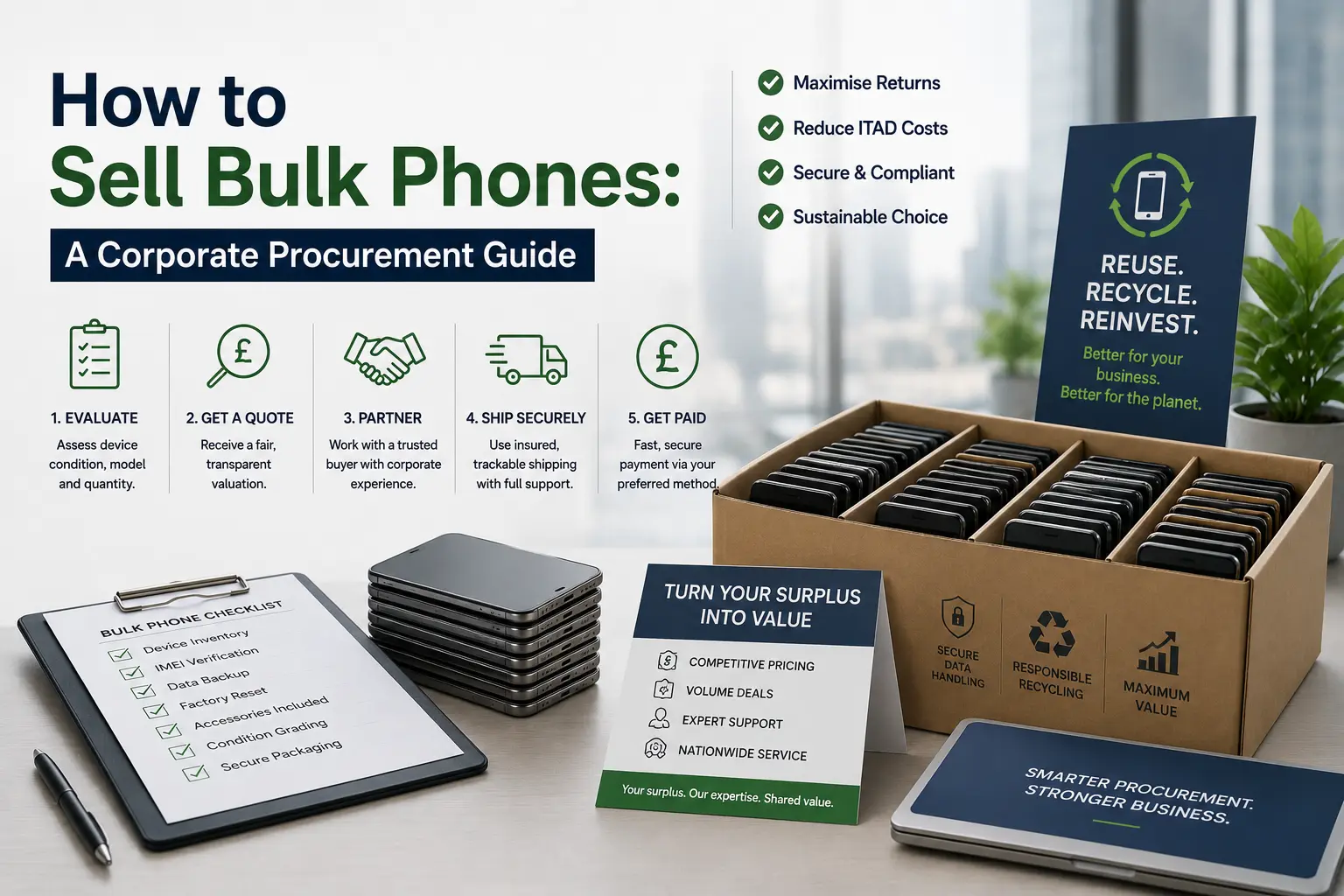
The Bulk Phone Trade-In Process — Step by Step
For procurement teams planning a bulk device disposal, here is what a well-run trade-in looks like from start to finish:
- Device audit and inventory — Compile an accurate list of all devices by model, age, and condition, reconciled against MDM records and asset registers.
- Online valuation — Submit device details via a B2B trade-in portal to receive an indicative quote based on model, volume, and condition.
- Logistics arranged — Dedicated van collection for large fleets; pre-paid courier boxes for smaller batches. The provider manages this.
- Receipt and quality check — Devices are received, individually assessed, and graded against the submitted inventory.
- Certified data destruction — NIST 800-88 and ADISA-aligned erasure is performed on every device; a serialised Certificate of Destruction is issued per device.
- Final valuation confirmed — Any condition-related pricing adjustments are communicated transparently before payment is processed.
- Payment issued — Within an agreed window, typically 14 days from receipt and quality check completion.
- ESG impact report delivered — CO₂ savings, devices reused versus recycled, and e-waste diverted from landfill, ready for sustainability reporting.
Selling company phones in bulk is one of the more straightforward ways to recover value from an IT refresh cycle — but only if it is approached as a considered procurement process rather than a last-minute disposal task. Three things determine whether it goes well or badly: how thoroughly the fleet is prepared before collection, how rigorously data security and WEEE compliance obligations are met, and whether the chosen corporate phone buyback partner can evidence the certifications, documentation, and processes that protect the business at every stage.
The financial case for acting promptly is clear: devices depreciate continuously, and secondary market dynamics in 2025–2026 make timing more commercially significant than ever. The compliance case is non-negotiable: GDPR liability does not end when a device leaves your office. And the ESG case is increasingly compelling: with only around 8% of UK WEEE currently being reused, choosing a provider that prioritises refurbishment over recycling delivers measurable carbon savings that can be evidenced and reported.
If you are planning a device refresh, managing a fleet decommission, or simply sitting on a backlog of unused handsets, iGo Trade In provides an instant bulk valuation via its self-service B2B portal — with certified data destruction, WEEE-compliant logistics, payment within 14 days, and an ESG impact report included as standard. Visit igotradein.co.uk to get started.
