
That Drawer Full of Old Android Phones Is Costing You Money
There are an estimated 83 million unused mobile phones sitting in UK households right now. Businesses are no better. Somewhere in nearly every company there’s a drawer, a shelf, or a whole storeroom slowly filling up with old Android handsets, quietly losing value every quarter they sit there.
For a household, a forgotten phone is a minor shame. For a business, it’s three problems at once: money you haven’t recovered, a data-protection risk you’re still carrying, and an ESG win you can’t claim because nobody’s measured it.
The fix isn’t complicated. It’s deciding to trade those phones in at the right time, through the right channel. This guide walks through how Android trade-in values stack up, Samsung, Google Pixel, OnePlus and the rest, what moves the numbers, and how to get the most back, whether you’ve got a handful of handsets or a fleet running into the hundreds.
Why Android Values Are All Over the Place
Apple makes this easy. One manufacturer, a tidy range, a predictable slide in value. Android is a different animal: dozens of makers, hundreds of models, and software support timelines that range from generous to non-existent.
So here’s the thing to hold onto: there is no single Android market. A Galaxy S24 Ultra and a budget Motorola are both “Android phones” in the way a racehorse and a Shetland pony are both horses. Premium devices from Samsung and Pixel hold genuinely useful resale value across a two-to-four-year refresh cycle. Mid-range and off-brand handsets drop like a stone, especially once software support ends or the next model lands.
Which is why “Android isn’t worth trading in” is one of those things people say that simply isn’t true. The right devices, traded in at the right moment, through the right programme, give you real money back. The trick is knowing which is which.
What Actually Moves the Numbers
Four things, mostly. None of them is abstract; each one shows up directly in the cheque you get back.
Tier and brand. Flagships hold value; everything else holds less. Samsung Galaxy S and Z series and the Pixel Pro models sit at the top. Mid-range A-series and smaller brands depreciate faster and return less, especially to B2B buyers who want enterprise-ready kit. Worth remembering at purchase time, not just disposal time: buying premium often means a better trade-in down the line, which softens the higher sticker price.
Software support, the one everyone forgets. When a phone stops getting updates, it becomes a security liability, and the second-hand market knows it instantly. Values can fall off a shelf around end-of-support news, faster than normal depreciation would explain. This is exactly why Samsung and Pixel have become the safe corporate bet: Samsung now promises seven years of updates on newer Galaxy S and A devices, and Google matches that on the Pixel 8 and later. On a three-to-four-year refresh cycle, that means your phones never get anywhere near end-of-life while you’re using them, so security and resale value both stay intact.
Condition, storage and lock status. Screen, chassis, battery health, whether it’s been reset and unlocked, all of it feeds the grade at inspection. And condition isn’t luck; it’s the cumulative result of how you looked after the fleet. MDM-managed resets, cases and screen protectors aren’t just good IT hygiene; they’re money in the bank later. Higher-storage versions of the same model fetch more too.
Timing. Values depreciate on a curve, but there are cliff edges. Every annual flagship launch from Samsung or Google knocks the value out of the model before it. End-of-support announcements do the same. Trade in six to twelve months before those moments and you keep meaningfully more. The lesson is blunt: delay costs money.
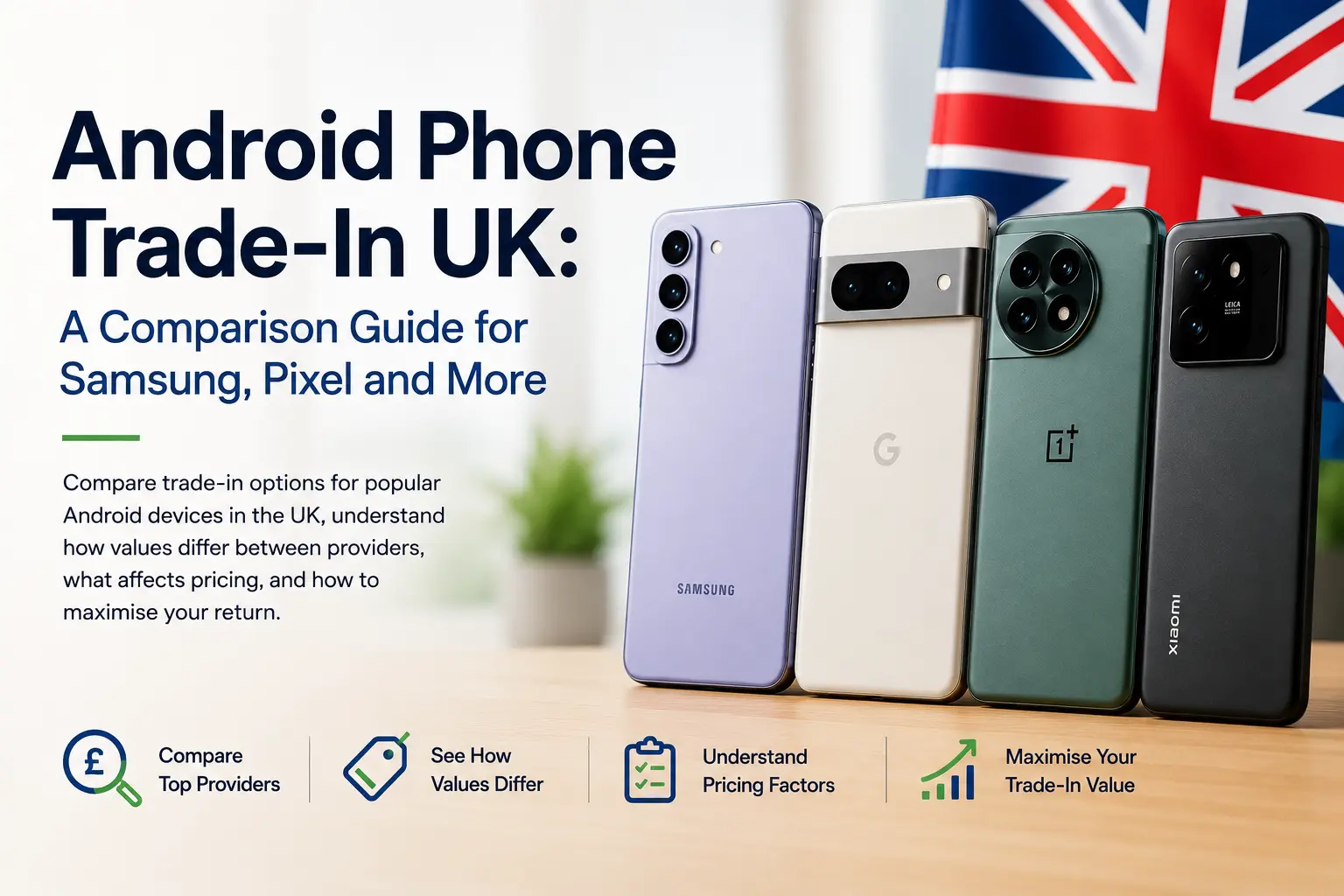
The Brand Rundown
A quick note: the specific models and update commitments below are current at the time of writing. The market moves fast, new flagships launch every year and support windows shift, so treat the named devices as a snapshot rather than gospel.
Samsung, the default for a reason
Samsung owns most UK corporate Android deployments, and the trade-in numbers follow. Knox security, broad MDM support and that seven-year update promise make it the most predictable, and usually the highest-value, Android brand for business trade-ins.
The Galaxy S flagships (S23, S24, S25) hold up well over a two-to-three-year cycle. The foldables, Z Fold and Z Flip, are rarer in corporate fleets but draw strong second-hand interest thanks to their high starting price and novelty. And because Samsung’s release schedule and update roadmap are so clearly published, you can actually plan your trade-in to land in the sweet spot.
Google Pixel, the credible challenger
Pixel has earned its place in serious corporate fleets, especially anywhere running Android Enterprise or wanting fast, clean security patching. The seven-year commitment on the Pixel 8 range makes it a real contender for longer cycles.
Pixel Pro models carry the strongest values; standard Pixels land solid mid-tier. The one caveat: Pixel’s enterprise footprint in the UK is smaller than Samsung’s, so demand for older models can be a little less liquid. At the premium end, though, values stay competitive, and the clean software and guaranteed updates are a genuine draw.
OnePlus, lovely phones, awkward fit
OnePlus gives you flagship hardware at a friendlier price, and the top models hold respectable consumer resale value. Corporate adoption is another story: MDM support is less mature, and update commitments have historically been shorter and patchier. If you’ve already got OnePlus in the fleet, flagship trade-ins are reasonable but tend to trail Samsung and Pixel at the same age. Advice: don’t sit on them.
Sony, Motorola, Xiaomi and the rest
Sony Xperia has a loyal niche and modest values. Motorola’s mid-range drops quickly but still returns something useful at volume. Xiaomi and other Chinese makers see softer UK demand, partly software-support uncertainty, partly lower enterprise take-up, so values run lower. The common thread is timing: the sooner these go, the better. Hold them and the depreciation just compounds.
A word on mixed fleets
Let’s be honest about reality. Almost nobody has a clean set of identical Samsung flagships. What you’ve actually got is a glorious jumble of brands, models and generations piled up over years. At that point, individual brand performance matters less than having a sensible plan. A proper trade-in programme handling 50 to 500 mixed devices will still recover real value, as long as they’re collected and processed efficiently and within the right age window. What you need is a partner who isn’t fazed by the mess.
Why the Channel Matters as Much as the Phone
Consumer platforms: fine for one phone, wrong for a fleet
Network buyback schemes, high-street trade-ins and online comparison sites do a decent job for a single device. They are not built for corporate disposal. No certified data destruction, no GDPR paperwork, no ESG reporting, and no sane way to process volume. Feeding 20, 50 or 500 devices through a consumer channel one at a time is a lot of admin, and doing it without documented data wiping is a genuine compliance risk.
What a proper B2B programme looks like
A real corporate trade-in partner gives you more than a price. You should expect instant bulk valuations through a self-service portal, logistics that flex with volume (a van for big fleets, pre-paid courier boxes for smaller batches), certified data wiping to ADISA and UK GDPR standards, a Certificate of Data Destruction for every device, payment within a clear window, and an ESG report covering e-waste diverted and carbon saved.
iGo Trade In is built for precisely this. It’s made for UK businesses managing corporate Android and Apple fleets, and it covers the whole journey: portal valuation, certified ITAD, full compliance paperwork and ESG reporting, as one managed process.
The Bit Your Compliance Team Will Ask About
GDPR and the ICO
This isn’t optional. Under UK GDPR, you’re responsible for the personal data on a device until it’s provably gone. The ICO-endorsed ADISA standard gives you an auditable framework for compliant wiping. A factory reset doesn’t meet it. Trade in without certified destruction documentation and you’re carrying real regulatory exposure.
Duty of care under environmental law
There’s also the Environmental Protection Act and the WEEE Regulations. Devices have to go to licensed waste carriers, with the handover recorded on waste transfer notes. WEEE amendments that came into force in August 2025 tightened the reporting rules further. An informal or unlicensed channel doesn’t cut it, and could land you with a duty-of-care breach.
What to check for
When evaluating any trade-in or ITAD partner, look for ADISA certification, Upper Tier waste carrier, broker and dealer registration with the Environment Agency, and full documentation at every stage, including Certificates of Destruction and waste transfer notes. ISO 27001 certification is a further mark of information security maturity worth checking for when assessing partners.
iGo Trade In holds ADISA certification, is a registered Upper Tier waste carrier, broker and dealer with the Environment Agency, and provides full documentation at every stage, including Certificates of Destruction and waste transfer notes.
The ESG Case (With Actual Numbers)
Here’s the maths that makes sustainability teams sit up. Making a single smartphone produces roughly 70-77 kg CO2e, and more than 80% of a phone’s lifetime emissions happen at manufacture, not in your pocket. Keep a device in use through reuse or resale, and you avoid building a new one, saving an estimated up to 45-55 kg CO2e per handset.
Scale that up, and it becomes boardroom material. Trade in 200 devices instead of stockpiling or binning them and you’ve avoided roughly 9 to 11 tonnes of CO2e, a Scope 3 reduction that drops neatly into corporate sustainability reporting.
The catch for most organisations isn’t willingness, it’s evidence. IT teams rarely have the data to turn “we recycled some phones” into a quantified carbon figure. Trade in through iGo Trade In and you get an ESG impact report with every batch, sizing up the e-waste diverted and carbon saved in a format that works for Scope 3 reporting, stakeholder decks and sustainability disclosures. It closes the gap between doing the right thing and proving you did.
How to Get the Most Back
Trade in before the cliff. Build it into refresh planning as a scheduled event, not a panic at the end. Aim to land six to twelve months ahead of end-of-support news and new flagship launches.
Prep the devices. Factory reset and unenrol from MDM, pull the SIM and SD cards, collate accurate model and storage details, and grade condition honestly. Tidy batches process faster and dodge valuation surprises after inspection.
Don’t dismiss the old and the odd. The idea that older or non-premium Androids aren’t worth bothering with is usually wrong once volume’s involved. In aggregate, even the also-rans add up to a real figure, provided your partner can route each device to the right second-hand market, or to responsible recycling where that’s the honest answer.
Is iGo Trade In Right for You?
If any of this has hit a nerve, a refresh creeping up, a mixed Android fleet gathering dust in storage, a compliance officer asking pointed questions about data destruction, or a sustainability report crying out for hard IT numbers, it’s worth a look.
You get a self-service portal for instant fleet valuations, UK logistics that scale from a single pre-paid courier box to a full van collection, certified ADISA and GDPR-compliant data destruction, payment within 14 days, a Certificate of Data Destruction, and an ESG impact report, all as one managed process.
iGo Trade In is part of the wider iGo Life ecosystem, which covers the full device lifecycle from fulfilment through to recycling. And for IT resellers, dealers and mobile channel partners handling trade-ins for clients, there’s a white-label option.
Get an instant fleet valuation at igotradein.co.uk, or get in touch to talk through what your business needs.
The Short Version
Android trade-in values swing a lot by brand, model, age and condition, but that’s manageable with the right information and the right partner. Samsung and Pixel premium devices hold value well on a structured cycle. Timing is everything, and waiting is expensive. Data security and WEEE compliance are legal duties, not nice-to-haves. And whatever the size of your fleet, a proper trade-in programme gets you more money back, less regulatory risk, and the ESG evidence your stakeholders increasingly want to see.
Treating trade-in as a planned part of IT asset management, rather than a last-minute chore, isn’t just good housekeeping. It’s good governance.

Leave A Comment