
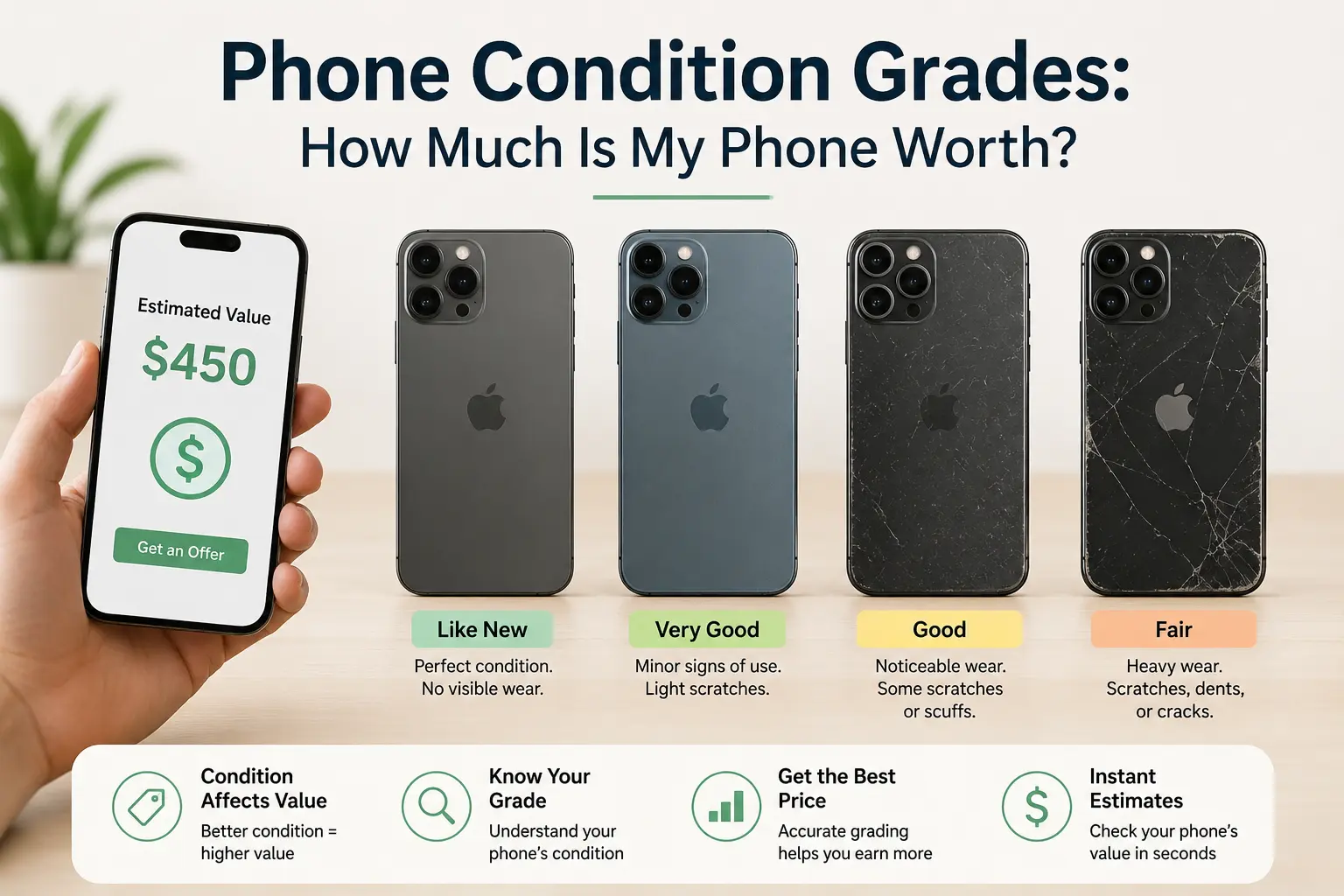
Picture two smartphones sitting on a desk. Same model, same age, same storage capacity — yet when they go through a trade-in assessment, one comes back with a significantly higher offer than the other. The difference has nothing to do with the spec sheet. It comes down entirely to condition.
For IT managers and procurement leads planning a device refresh cycle, the question of *how much is my phone worth* is rarely about a single handset. It is about an entire fleet — 50, 100, or 500 devices — where the aggregate difference between condition grades can represent thousands of pounds in recovered value. Understanding how phone condition grading works is not background knowledge for tech enthusiasts. It is a commercially relevant skill for anyone responsible for managing device lifecycle costs.
This guide walks through exactly what Good, Fair, and Poor phone condition grades mean in practice, what assessors look for when grading devices, and how you can use that knowledge to accurately estimate value before trading in — reducing surprises, improving business cases, and making the most of your hardware investment.
Why Phone Condition Grades Matter for Trade-In Value
Condition grades are a commercial language, not a consumer-facing description. When a trade-in assessor assigns a grade to a device, they are communicating two things: how much refurbishment work the device needs, and how strong the secondary market demand for that device is likely to be. Those two factors together determine the margin available to pass back to your business.
A device graded Good requires minimal processing before it can be resold. A device graded Fair needs cosmetic restoration, possibly screen polishing or chassis repair. A device graded Poor may only be suitable for parts harvesting. Each step down the grading scale represents additional cost for the trade-in partner — and a lower offer for your organisation.
For businesses trading in at scale, this matters enormously. Across a fleet of 100 devices, the difference between a Good and Fair assessment is not academic. Multiply it out, and that gap can represent a material difference to the business case for a refresh project. Most ITAD (IT Asset Disposition) providers share broadly consistent grading criteria, even if the terminology differs — A/B/C, C1 to C5, or Good/Fair/Poor are all variations on the same framework. Once you understand the underlying logic, you can interpret any vendor’s grading system with confidence.
The Three Core Condition Grades — What They Actually Mean
Good — Light Wear, Full Functionality
A Good-grade device is the benchmark for trade-in. It has clearly been used, but it has been well looked after. The screen is intact — no cracks, no deep scratches visible under normal lighting. The chassis shows only very minor surface marks, if any. All buttons and ports function correctly, the camera and speakers work as expected, and the battery holds a reasonable charge. Minor surface scuffs that are only visible under direct light are typically acceptable at this grade; anything more prominent will push the device toward Fair.
Commercially, Good-condition devices are prioritised for direct resale or very light refurbishment. That means lower processing costs and higher returns for your business. These are the devices that come closest to the headline trade-in rates published by vendors.
Quick self-check for a good grade:
– Screen: no cracks, no visible scratches under normal light, full touch responsiveness
– Chassis: no dents, chips, or significant scuffs
– Buttons and ports: all physically intact and functioning
– Battery: holds a reasonable charge (check health percentage in device settings)
– Software: factory reset, accounts removed, MDM profiles offboarded
Fair — Visible Wear, Still Functional
Fair-grade devices show clear signs of use. Multiple scratches are visible without close inspection, there may be light dents or minor cosmetic damage, and the overall appearance reflects a device that has had an active working life. Crucially, the device must still function fully — calls, connectivity, touchscreen, camera, and all core features should operate correctly.
The key distinction from Good is that the cosmetic wear is immediately visible rather than only apparent under scrutiny. Some grading frameworks will also permit minor missing elements at Fair level — for example, an absent original charger, though this varies by provider.
Fair-grade devices still carry recoverable value, but the trade-in offer will account for the refurbishment work required before resale: screen polishing, cosmetic restoration, or chassis repair. The most common source of friction in B2B trade-ins is businesses assuming their fleet sits at Good when it actually grades Fair. That assumption leads to downward price adjustments post-inspection, delayed payments, and frustrated IT teams. The more accurately you assess your devices upfront, the smoother the process will be.
Poor — Heavy Damage or Compromised Function
Poor-grade devices have either heavy cosmetic damage — cracked screens, significant chassis damage, deep gouges — or functional issues such as battery failure, unresponsive touch, or faulty ports. It is worth noting that a device can be graded Poor even if it powers on and appears to work. A badly cracked screen or severe cosmetic damage is sufficient to place a device in this tier, because the refurbishment cost makes it commercially unviable for standard resale.
Devices in Poor condition are typically only suitable for parts harvesting rather than full refurbishment. Trade-in returns are substantially lower, and in some cases, the primary value is not financial at all — it lies in responsibly diverting the device from landfill. For Poor-condition devices, the ESG outcome (e-waste diversion, responsible recycling) becomes a more relevant measure of success than cash recovery.
What Assessors Actually Look At — The Grading Criteria
Professional grading goes beyond a quick visual inspection. Understanding what assessors evaluate in detail helps explain why the grade they assign sometimes differs from your internal estimate.
Screen condition is typically the most weighted factor — assessors look for scratches, cracks, dead pixels, pressure marks, and full touch responsiveness across the entire display area.
Chassis and body covers all four corners, the back panel, camera lens, and frame — specifically checking for dents, chips, bending, or missing components.
Buttons, ports, and speakers are tested physically: volume buttons, power button, all charging and audio ports, speaker output, and microphone function.
Battery health is assessed against original capacity — many ITAD providers apply a minimum threshold, with batteries below around 80% of original capacity flagged for replacement or impacting grade.
Software and activation status is non-negotiable. Devices must be factory reset, with iCloud and Google accounts removed and any MDM (Mobile Device Management) profiles offboarded. Devices that remain locked to an MDM system may be held or returned regardless of their physical condition — this is a frequent and entirely avoidable issue in corporate trade-ins.
Accessories and completeness are noted but generally have a minor impact on grade, though they may affect the final offer.
How Condition Grades Translate to iPhone Trade-In Value
iPhones dominate corporate mobile fleets across the UK, and iPhone trade-in value is consistently one of the highest among any smartphone category — which makes condition grading an even more critical variable. The residual value of an iPhone holds well relative to most Android alternatives, meaning the absolute financial gap between a Good and Fair assessment can be proportionally significant. For an IT manager refreshing a fleet of 50 or 100 iPhones, that gap, multiplied across every device, has a real impact on the business case.
When assessing iPhone trade-in value across a corporate fleet, condition is the single most influential factor your business can control. The model, storage tier, and age are fixed — but how devices have been managed, stored, and maintained determines which grade they achieve. Given that the average corporate device lifecycle sits at around three years, devices traded in at the point of refresh can still command Good or Fair grades — provided they have not been stockpiled beyond their useful window or stored poorly after decommissioning.
The iPhone trade-in value your business recovers depends heavily on the grade each device achieves. A well-managed fleet, traded in at the right time, consistently outperforms one that has been left in drawers for six months post-refresh.
The Cost of Waiting — How Delay Degrades Condition and Value
One of the most common and costly mistakes in corporate IT asset management is deferring the trade-in decision. Devices that sit unused in stockrooms or desk drawers do not hold their value — they quietly lose it.
A phone that would have graded Good at the end of its refresh cycle can drop to Fair after six to twelve months of improper storage. Batteries degrade faster when stored at poor charge levels. Screens and chassis accumulate unnoticed damage during repeated handling and movement. And the secondary market value of older models decreases over time regardless of condition, as newer generations enter the market and push residual prices down.
There is also an environmental dimension here. According to GSMA research, approximately 80% of a smartphone’s lifetime carbon footprint occurs during manufacturing. That means reuse and refurbishment generate significantly greater carbon savings than recycling alone — and a device that retains a Good condition grade is far more likely to be refurbished and resold. Once a device drops to Poor, its most probable outcome is parts harvesting or recycling, which delivers a fraction of the environmental benefit. Timing a trade-in well is not just a financial decision — it is an ESG one.
Data Security and Condition Grading — What Businesses Must Not Overlook
One area that distinguishes a business trade-in from a consumer sale is the non-negotiable requirement for certified data destruction. Regardless of condition grade, every device leaving your organisation must have its data irreversibly removed before trade-in or resale. Factory reset alone is not sufficient.
The ICO is clear that organisations must ensure personal data is completely irretrievable before devices are disposed of or resold. The NCSC similarly advises that simple deletion or factory reset does not meet the standard required — certified sanitisation is necessary. UK GDPR Article 17, which enshrines the right to erasure, reinforces these obligations. With ICO guidance evolving further following the Data (Use and Access) Act, which came into effect in June 2025, expectations around data handling at device end-of-life are only moving in one direction.
A reputable ITAD or trade-in provider will carry out certified data wiping as part of the process and issue a Certificate of Destruction that provides auditable evidence of compliance. For any business handling sensitive or regulated data, this is not an optional extra — it is a baseline requirement.
iGo Trade In’s data destruction process is certified to NIST, ADISA, ISO, and ITAD standards, fully GDPR-compliant, and backed by a Certificate of Destruction issued with every trade-in. As a registered Upper Tier waste carrier, broker, and dealer with the UK Environment Agency, the compliance credentials are both genuine and auditable — not a marketing claim.
How to Self-Assess Your Devices Before Trading In
Running an internal grading exercise before approaching a trade-in provider reduces the risk of misaligned expectations and helps your team build a more accurate business case for the refresh project. Here is a practical framework to apply:
- Screen test — inspect under natural light for scratches, cracks, or dead pixels; test full touch responsiveness across the entire display
- Body inspection — check all four corners, the back panel, and the camera lens for chips, cracks, or significant scuffs
- Hardware function — test volume buttons, power button, all ports, speakers, and microphone
- Battery health — check the percentage in device settings (on iOS: Settings > Battery > Battery Health; on Android, this varies by manufacturer)
- Account and software status — confirm iCloud or Google accounts have been removed and MDM profiles have been fully offboarded
- Honest overall assessment — grade each device against the Good/Fair/Poor criteria and, if in doubt, assume the professional assessment may come in one grade lower than your estimate
Self-assessment is a useful starting point, but professional grading will always be the definitive standard. The goal is not to predict the exact outcome — it is to go into the process with realistic expectations, avoid surprises, and plan your budget accordingly.
Trading In at Scale — What Businesses Should Expect from a B2B Trade-In Process
For most readers of this guide, the question of how much my phone is worth is not about one handset — it is about a fleet. A structured B2B trade-in process looks quite different from handing a single device over a counter.
The process typically begins with a bulk device submission and instant valuation, followed by collection logistics scaled to the size of the fleet — van collection for larger batches, pre-paid courier boxes for smaller submissions. Devices are professionally graded and data-wiped on receipt, an offer confirmation is issued, and payment follows — typically within 14 days. Alongside payment, businesses receive a Certificate of Destruction and an ESG impact report quantifying carbon savings and e-waste diverted from landfill.
iGo Trade In is purpose-built for exactly this context. The self-service portal enables IT teams and procurement leads to submit bulk device lists and receive instant valuations without committing upfront. Flexible collection options, certified data destruction, GDPR compliance, and the ESG impact report are all included as standard — not charged as extras. For organisations that need to demonstrate environmental responsibility alongside financial recovery, having quantifiable impact data to bring to stakeholders and boards makes a tangible difference.
The answer to how much my phone is worth is never just about the model — it is primarily about the condition. Good, Fair, and Poor grades directly translate to different levels of refurbishment cost and secondary market demand, and across a corporate fleet, those differences compound into meaningful financial outcomes.
The practical takeaways are straightforward: understand the grading criteria before you trade in, self-assess honestly, do not stockpile devices beyond your refresh cycle, and ensure data destruction is certified rather than assumed. Getting these fundamentals right consistently protects the value your business can recover.
If you are approaching a device refresh or looking to understand what your current fleet might be worth, iGo Trade In’s portal lets you submit a bulk device list and receive an instant valuation — no commitment required. igotradein.co.uk to get started, or get in touch with the team if you would prefer to talk through the process first.

Leave A Comment