
Across Europe, an estimated 700 million smartphones are sitting unused — gathering dust in drawers, collecting in desk pedestals, depreciating quietly while their owners put off the decision to trade them in. Many of those devices are Samsung Galaxy phones, and many of their owners are leaving real money on the table.
Whether you are an individual looking to offset the cost of your next upgrade or a business managing a corporate device fleet, getting the timing, condition, and channel choice right can meaningfully change the outcome of a Samsung trade-in. The difference between a well-timed, well-prepared trade-in and a last-minute, post-launch submission is not trivial — in some cases, it can mean hundreds of pounds in recovered value, or almost nothing.
This guide covers everything you need to know to make the most of a Samsung trade-in in the UK in 2026: how the official programme works, what your Galaxy device is realistically worth, which variables affect your offer, how to use promotional windows to your advantage, and how Samsung’s programme compares with third-party alternatives. If you manage devices at a business level, there is a dedicated section covering the additional considerations that come with fleet-scale trade-ins.
How the Samsung Trade-In Programme Works in the UK
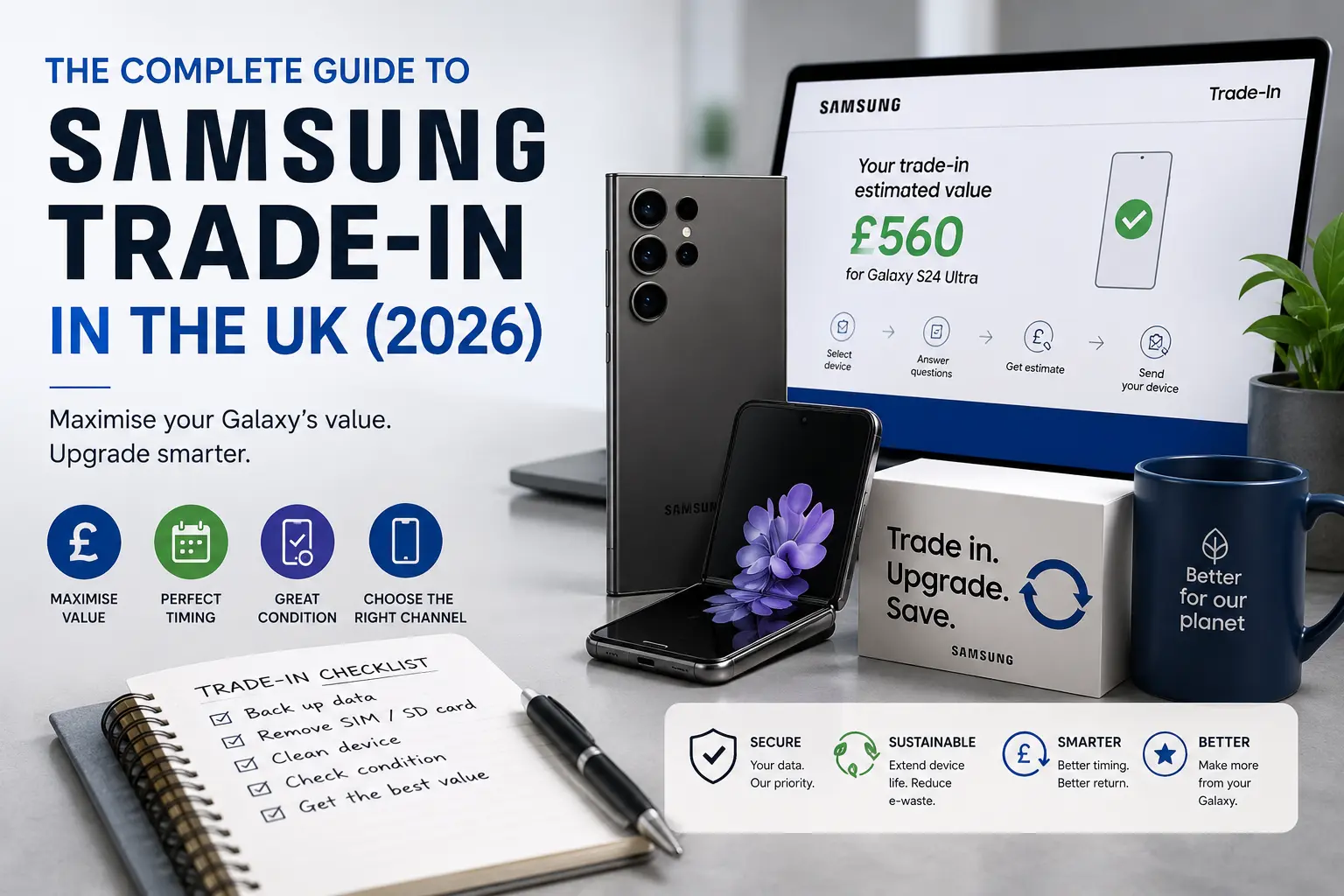
Samsung’s official UK trade-in programme, available via samsung.com/uk/trade-in, allows customers to submit a device for valuation and receive either an instant discount at the point of purchase or Samsung store credit. The process involves selecting your device model, answering a set of condition questions, and receiving an estimated trade-in value. If you accept, Samsung arranges collection or return, inspects the device, and confirms the final value.
Trade-in value is determined by four primary factors: model, age, condition, and current market demand. The programme is designed to make the upgrade journey smoother for existing Samsung customers — it is straightforward, integrated, and requires no third-party involvement.
Trading In at the Point of Purchase vs. Anytime Credit
Historically, Samsung’s trade-in programme was most commonly used at the moment of purchasing a new device — with the trade-in value applied as an instant discount on the new handset. That model still exists and remains the most common route for customers in the middle of an upgrade.
However, in July 2025, Samsung updated its UK offering to allow customers to trade in devices at any time — not just when buying something new — with the value converted into Samsung store credit. This is a meaningful shift in flexibility. Rather than having to trigger a trade-in only when you are ready to buy, you can now lock in value earlier and spend the credit later within Samsung’s ecosystem.
The practical distinction is worth thinking through carefully. An instant discount on a new purchase is straightforwardly useful if you are definitely buying Samsung. Store credit is similarly convenient if you are a committed Samsung customer who knows they will remain in the ecosystem. But for individuals or businesses prioritising maximum cash recovery — or those who want flexibility to buy elsewhere — store credit has obvious limitations compared to a direct cash payment from a buyback service.
What Happens to Your Device After Trade-In
Once Samsung receives your traded-in device, it undergoes a formal assessment. Devices in good enough condition are refurbished and resold through Samsung’s certified pre-owned channels, extending their useful life and reducing demand for new raw materials. Devices that are too worn or damaged for reuse should be handled in accordance with the UK’s Waste Electrical and Electronic Equipment (WEEE) regulations, which require proper treatment via authorised facilities rather than disposal into general waste. This matters not just environmentally but legally — for businesses especially, duty of care over how disposed devices are handled extends across the entire disposal chain.
What Is Your Samsung Galaxy Worth? Trade-In Values by Model
Trade-in values vary considerably across the Samsung Galaxy range, and any specific figures quoted today will likely be outdated within weeks. Rather than anchoring expectations to figures that move with the market, it is more useful to understand the value tiers and the principles that govern them.
Flagship Galaxy S Series
The Galaxy S series — currently anchored by the S25 range — commands the highest absolute trade-in values of any Samsung line. These are premium devices with strong secondary market demand, and in the months immediately following launch, they hold their value reasonably well. The window for maximum return, however, is narrow. Values begin softening as soon as the successor is rumoured, and drop more sharply once a new S-series is formally announced or launched. Trading in a current-generation S-series device in the months before the next launch cycle typically yields meaningfully more than waiting until after the announcement.
Galaxy Z Fold and Z Flip — Foldables as a Special Case
Foldable devices occupy a distinct segment. Their higher original purchase prices mean higher absolute residual values, which is positive. The complication is that secondary market demand for foldables remains more niche than for traditional slabs — there is a smaller pool of buyers, which can affect how competitively a buyback service prices them. Foldables are worth trading in, but it is worth comparing several channels to ensure you are accessing the best available offer rather than accepting the first valuation you receive.
Galaxy A Series and Older Models
The mid-range Galaxy A series and older flagship generations carry lower trade-in values in absolute terms, but that does not mean they lack recoverable value. A device sitting unused depreciates further with every passing month. Modest returns are still genuine returns — and trading in sooner rather than later prevents the device from crossing the threshold where it loses any meaningful market value at all.
What Affects Your Samsung Trade-In Offer?
Understanding what drives a trade-in valuation puts you in a far stronger position — both to maximise your offer and to avoid the unpleasant experience of a post-inspection downgrade. These are the variables that matter most.
Device Condition and Physical Grading
Trade-in services typically grade devices across a spectrum from “like new” through “good,” “fair,” and “poor.” The financial gap between grades can be substantial. Scratches, cracked screens, damaged charging ports, and faulty buttons all reduce the assessed grade and, with it, the offer. The important thing to understand is that your self-reported condition at the point of valuation will be verified at inspection — and if the device comes back lower than declared, the offer will be revised downward. Honest self-assessment upfront avoids delays, disputes, and disappointment.
Storage Capacity
Higher storage variants consistently return higher trade-in values. A 512GB Galaxy S24 Ultra will achieve more than its 256GB equivalent, all else being equal. For businesses planning device refresh cycles, this is worth factoring into procurement decisions — the storage tier of a device affects not only its utility during service life but its residual value at the end of it.
Battery Health
Battery condition is an increasingly scrutinised element of trade-in assessments. Significant degradation — visible via native Android diagnostics or third-party apps — can trigger a grade reduction. Before submitting a device for valuation, it is worth checking the battery health and factoring any degradation into your expectations. A device with a battery at 75% of original capacity is unlikely to achieve the same valuation as one with a healthy battery, even if the physical condition is otherwise identical.
Network Lock Status (Unlocked vs. Locked)
Unlocked devices carry broader secondary market appeal because they can be resold to customers on any network. Network-locked handsets may attract a small valuation penalty as a result, though it is worth noting that the majority of Samsung devices sold through UK retailers in recent years have been supplied unlocked by default.
Market Demand and Launch Timing
Perhaps the most underappreciated variable is timing. Trade-in values are not static — they respond to secondary market supply and demand, and they move in fairly predictable patterns around Samsung’s launch calendar. When a new Galaxy S-series is announced, demand for the outgoing model softens and values follow. Acting before an announcement rather than after is one of the single most effective ways to protect the return on a device.
Samsung Trade-In Offers and Promotional Bonuses — How to Make the Most of Them
Samsung periodically runs enhanced trade-in promotions that offer meaningfully higher values than standard baseline rates. These windows are typically aligned with major product launches — most notably the Galaxy S series refresh in Q1 and the foldable update in the second half of the year — and represent genuine opportunities to extract additional value from an older device.
When Do Samsung Trade-In Promotions Run?
The most reliably generous promotional windows tend to coincide with Samsung Unpacked events, new product launches, and major retail periods such as Black Friday. During these periods, the Samsung trade-in offer can be substantially above the standard rate — sometimes significantly so — but the window is usually time-limited and tied to the purchase of a specific new device. Watching Samsung UK’s communications and setting alerts around key launch periods is a practical step that costs nothing but can make a real difference to the final figure.
How to Stack Your Trade-In Offer With Other Deals
It is worth exploring whether a Samsung trade-in value can be combined with other incentives — network operator promotions, cashback offers through retailers, or bundle deals. The terms around combining offers vary and can change with each promotion, so it is important to read the conditions carefully rather than assuming any combination is automatically available. The broader principle, however, is sound: thinking strategically about the total package — trade-in value plus promotional uplift plus any other available deal — will almost always yield a better outcome than accepting the first offer in isolation.
Samsung Trade-In vs. Third-Party Buyback Services
For anyone serious about maximising the financial return on a Galaxy device, understanding how Samsung’s official programme stacks up against third-party alternatives is essential.
The Case for Using Samsung’s Official Programme
Samsung’s own trade-in programme offers simplicity and integration. The process is well-established, the brand is trusted, and for customers who are definitely buying a new Samsung device, the instant discount mechanism is genuinely convenient. The 2025 update allowing anytime trade-in for store credit adds further flexibility for those committed to the Samsung ecosystem. If simplicity and a seamless upgrade experience are the priority, the official programme is a reasonable choice.
The Case for Third-Party Buyback and Resale
Third-party platforms — specialist buyback sites, recommerce marketplaces, and ITAD providers — typically offer cash payment rather than store credit. For anyone who values financial flexibility over ecosystem convenience, this is a material difference. Cash can be spent anywhere; store credit cannot. Third-party services frequently offer more competitive returns on flagship devices in good condition, and they give you the freedom to buy your next device through whichever channel offers the best deal, rather than tying you to Samsung’s own store. The trade-off is slightly more friction in the process — but for higher-value devices, the additional effort is almost always worthwhile.
What to Watch Out For With Any Trade-In Channel
Regardless of which channel you use, there are a few pitfalls worth watching for. Post-inspection offer reductions are common — submitted condition and assessed condition do not always align, and the difference is almost always resolved in the service’s favour. Grading criteria vary between providers and are not always clearly defined upfront. Some services apply deductions for missing accessories or original packaging. Payment timelines also vary considerably. Before committing to any trade-in, read the terms carefully, understand what happens if your condition assessment is downgraded, and compare at least two or three offers to establish a realistic market rate for your specific device.
Timing Your Trade-In for Maximum Return
Timing is arguably the single most controllable variable in a Samsung trade-in. Everything else — condition, storage, network status — is largely fixed by the time you decide to trade in. Timing is the one lever you can actively manage.
The Depreciation Curve — Why Waiting Costs You Money
Flagship smartphone values follow a fairly characteristic depreciation curve. In the first six to twelve months after launch, values hold reasonably well. Then, as the successor model approaches — first in rumour, then in announcement, then in release — values drop, often sharply. Devices traded in four to eight weeks before a new Samsung launch typically achieve materially better returns than those traded in after the news breaks. Every week spent deliberating after a launch announcement is a week of avoidable depreciation.
Aligning Trade-In Timing With Samsung’s Launch Calendar
Samsung’s annual rhythm is reasonably predictable. The Galaxy S series typically launches in Q1, with Samsung Unpacked events in the early months of the year. Foldable refreshes — Z Fold and Z Flip — tend to follow in the second half of the year. Monitoring Samsung UK’s announcement schedule and treating upcoming launches as a prompt to act — rather than a reason to wait and see — is a sound and simple strategy. The best time to submit a trade-in is almost always before the announcement, not after.
Practical Tips to Maximise Your Samsung Trade-In Value
A few straightforward steps before submitting a device can make a genuine difference to the offer you receive.
Start by checking battery health through the device’s built-in diagnostics. Significant degradation is worth knowing about before valuation — it sets realistic expectations and avoids surprises at inspection. Next, clean the device physically: remove the case, wipe the screen, and check for visible damage you might have stopped noticing through daily familiarity. Digitally, remove all accounts, disable any activation locks, and perform a factory reset — a device that arrives clean and fully accessible is easier to process and less likely to attract deductions.
If you have the original box, charger, and cable, include them. While accessories rarely transform a valuation, they signal that the device has been well looked after, which supports a higher condition grade. Be honest in your condition self-assessment — it is always better to report accurately and receive a consistent offer than to overstate condition and face a downward revision after inspection.
Compare offers across at least three channels before committing: Samsung’s own portal, at least one specialist buyback site, and if the device is in particularly good condition, consider whether the open market might yield more. And finally, act before the next launch. If you know a new S-series is expected in Q1, do not wait until February to start the process.
What About Businesses Trading In Corporate Samsung Devices?
The guidance above applies well enough for individual consumers and small-scale trade-ins, but it has real limits when scaled to a corporate environment. For IT managers, procurement leads, and fleet owners handling device refreshes across 50, 200, or 500-plus devices, the variables change significantly — and OEM programmes like Samsung’s are simply not designed to meet those needs.
Samsung’s trade-in programme is optimised for individual, transactional use. It does not provide the bulk logistics infrastructure, certified data destruction documentation, compliance audit trails, or ESG reporting that UK businesses require under GDPR, WEEE regulations, and increasingly demanding stakeholder reporting expectations. A business disposing of corporate devices has a legal duty of care that extends to how those devices are handled, wiped, and either refurbished or recycled — and “traded in through the manufacturer’s portal” is rarely sufficient as a compliance process on its own.
This is where a platform like iGo Trade In is specifically relevant. Built for UK businesses managing device refreshes at scale, iGo Trade In handles the full disposition process: certified GDPR-compliant data destruction aligned to NIST, ADISA, and ISO standards; flexible collection logistics with dedicated van service for large fleets or pre-paid courier options for smaller batches; payment within 14 days; and a Certificate of Destruction issued as standard. Every trade-in also comes with an ESG impact report documenting e-waste diverted and carbon savings — directly useful for sustainability reporting to boards, clients, and procurement stakeholders. iGo Trade In is a registered Upper Tier waste carrier, broker, and dealer with the UK Environment Agency, providing the auditable downstream assurance that corporate compliance requires.
The Bigger Picture — Samsung Trade-In and the UK’s Circular Economy
Individual and corporate trade-in decisions sit within a wider context that is worth briefly acknowledging. The UK generates approximately 375,000 metric tonnes of WEEE annually, and globally, less than one-third of e-waste is formally collected and recycled. The 700 million unused phones sitting idle across Europe represent not just unrealised financial value but a significant missed opportunity for material recovery and carbon savings. Extending a device’s useful life through reuse and refurbishment delivers substantially greater environmental benefit than recycling alone — the energy and materials embedded in a working device are preserved when it finds a second user, rather than being partially recovered through a recycling process. Every trade-in decision, whether individual or corporate, is a small but genuine contribution to closing that gap.
The key takeaways from this guide are straightforward: timing matters more than most people realise, condition is largely within your control, and comparing offers before committing is always worth the effort. Do not let a Galaxy device depreciate unused when the secondary market will pay for it — the gap between acting now and acting after the next launch announcement can be significant.
For individual Galaxy owners, the path is clear. Check Samsung’s trade-in portal, compare at least one or two third-party buyback offers, account for any active promotional windows, and act before the next launch cycle narrows your options.
For business readers managing corporate device fleets, the same principles apply — but the execution looks different. Fleet-scale trade-ins require certified data destruction, documented compliance, reliable bulk logistics, and the kind of ESG reporting that a manufacturer’s trade-in programme is not built to provide.
If you are managing a device refresh at scale and want to understand what your fleet is worth — and how to recover that value compliantly and efficiently — explore what iGo Trade In can offer at igotradein.co.uk. Get an instant valuation, or get in touch to discuss your specific requirements.
The best time to trade in was before the last launch. The second-best time is now.

Leave A Comment